Traeger
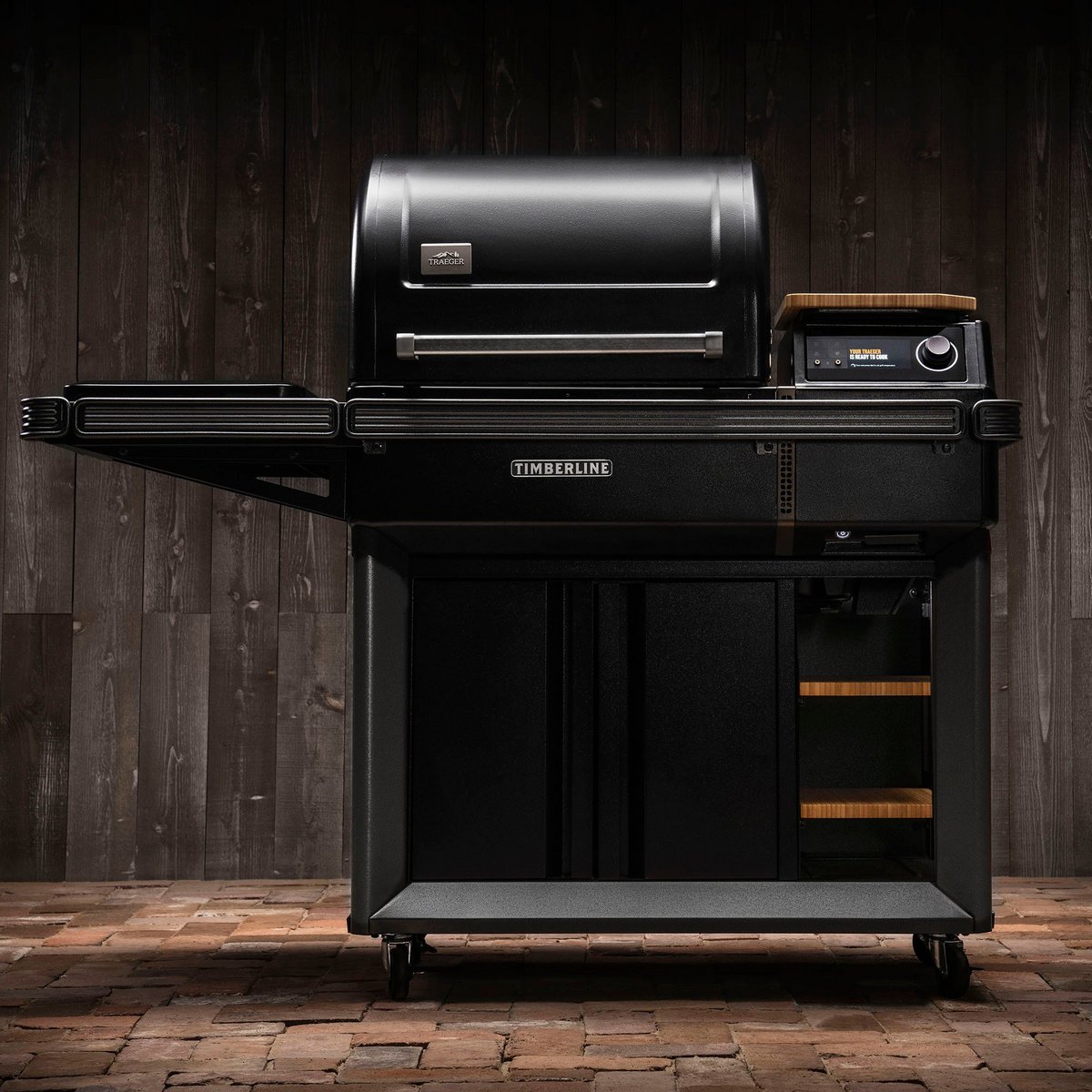
Traeger Timberline
The smaller of Traeger's two flagships: 880 sq in across three racks in a stainless cabinet, with an electric induction cooktop built into the left side and a soft-close lid. It ships with two wired probes and two Traeger x MEATER wireless thermometers. The only difference from the $4,000 Timberline XL is chamber size — 880 sq in against 1,320.
Goes to the manufacturer. We earn nothing on this one.
Specifications
Features
Pros
- ✓Induction side cooktop needs no propane and holds real searing heat, unlike a pellet sear zone
- ✓Four thermometer channels out of the box — two wired, two wireless MEATER probes
- ✓Three-rack layout gives more usable tiers than any two-rack grill of similar square inches
- ✓Stainless construction and a gasketed, soft-close lid hold temperature through wind and cold better than painted steel
- ✓Same 10-year warranty as the rest of the current Traeger line
- ✓$500 less than the Timberline XL for the same hardware in a smaller body
Cons
- ✗3.7 out of 5 across 318 reviews on Traeger's own store; controller and app reliability are the recurring themes
- ✗500°F ceiling is no higher than an $899 Woodridge — the premium buys build and features, not heat
- ✗22 lb hopper is the same as the Ironwood at nearly double the price
- ✗Induction cooktop is a 120V draw on the same circuit as the grill, which can trip a shared outdoor breaker
- ✗At $3,500 it is squarely in Yoder and MAK welded-steel territory, where the steel is thicker and the electronics simpler
Owner Insightssummarized from owner discussions
The Timberline is the smaller of Traeger's two flagships, and what separates it from the far cheaper Ironwood is the stainless cabinet, the insulation and the induction cooktop built into the side. The insulation is the part owners defend most readily; one cooking through Michigan winters credits the fully insulated Timberline design directly, and cold-weather performance is what the name reliably earns. The induction top is the other genuine differentiator, and the pricing logic holds up better than it first appears: Traeger sells an induction top for the Ironwood at over $1,300, which as owners point out puts that combination at Timberline money anyway, without the cabinet or the insulation.
Be aware that most accumulated owner experience under this name belongs to the previous generation, the 850 and 1300, and some of it is bad in ways Traeger has since addressed. The integrated grease management on those grills produced dirty fires above 350°F and flare-ups that drove owners away, and Traeger dropped that system on the current design, which is the single strongest argument for the new grill over a used older one. Other complaints carry over because they are not about the chassis. The app is widely disliked, with owners describing the grill appearing and disappearing between days and passing around a power-cycle workaround. Smoke output is the fundamental limit: a cook who ran beef chuck ribs nine hours with four on Super Smoke described the result as tasting baked rather than smoked, and a five-year Traeger owner's distilled advice is both that you will never match an offset and that chasing 225°F for smoke is counterproductive because it renders fat poorly, so cooking hotter gives better results.
It suits a buyer who wants an outdoor kitchen appliance rather than a smoker: something that looks right built into cabinetry, works through a real winter, needs almost no ash management and puts a searing surface next to the chamber. The honest caveat is that the people best placed to sell you one do not always push it. A Traeger dealer told one shopper the Timberline was overkill and the Ironwood would last him a decade, and at this price it is cross-shopped against Yoder, Recteq's larger units and Lone Star Grillz, where buyers comparing all of them note the Timberline asks the most and reviews the weakest. 880 square inches is also less generous than the price implies; owners of earlier Timberlines describe the format as a single-meat smoker.
What owners like
- +The insulated cabinet is the feature owners in cold climates single out. One who runs his year-round through Michigan winters credits the full insulation of the Timberline line specifically, and cold-weather capability is the most consistent praise the name attracts
- +The built-in induction cooktop is the reason to consider this over the Ironwood, and the pricing makes the case: Traeger's separate induction top for the Ironwood runs over $1,300, which owners point out lands that grill in Timberline territory anyway
- +The ash keg makes routine maintenance close to automatic. Owners describe the grill as largely self-clearing between cooks, with the question being how often to do a deep clean rather than whether ash needs dealing with each time
- +It is designed to be built in, and Traeger publishes dimensioned guidance for contractors. An owner who installed his into an outdoor kitchen followed that guide and was happy with the result
- +The stainless grates are good enough that owners of cheaper Traegers go out of their way to get them, ordering Timberline grates through Traeger support to retrofit into an Ironwood
Common complaints
- −Smoke flavor is the pellet platform's ceiling and price does not raise it. One cook who ran beef chuck ribs for nine hours on a Timberline, four of them on Super Smoke, said the result tasted baked rather than barbecued, and a five-year Traeger owner's summary is that you will never get offset smoke out of a pellet grill
- −The value case is contested by people with no reason to talk you out of it. A platinum Traeger dealer told one shopper the Timberline was overkill and that the Ironwood line would serve him for the next decade, and buyers regularly arrive asking whether anything justifies the price
- −At this money the competition is stiff and often better regarded. Shoppers cross-shop it against the Yoder YS640S, Recteq's Dualfire and BFG, and Lone Star Grillz, and one weighing all three noted the Timberline carried both the highest price and the weakest reviews of the group
- −Traeger's app has a poor reputation among Timberline owners. One described it as the most inconsistent hardware app he had used, with the grill visible one day and invisible the next; the workaround owners pass around is cycling the power switch on the back of the unit
- −Traeger's out-of-warranty support has soured owners. One whose earlier Timberline developed a rusted grease channel at four and a half years, kept covered under a covered deck, found the part was not sold separately and was offered a discount on a new grill instead of a repair
- −880 square inches is not as much as it sounds on a cooker this size. An owner of an earlier Timberline called it a single-meat smoker and moved to something larger to run multiple cuts or add sides alongside a brisket
Common Questions
Is it worth the money over an Ironwood?
How much smoke flavor does it produce?
Does it handle cold weather?
Is the Traeger app reliable?
How does it compare to the older Timberline 850 and 1300?
Compare the Traeger Timberline
Related grills
More from Traeger →
Traeger
Traeger Timberline XL
The Traeger Timberline XL is Traeger's top-of-the-line flagship pellet grill, with a fully insulated double-wall body, induction side burner, and a touchscreen controller. It's aimed at serious enthusiasts.
Traeger
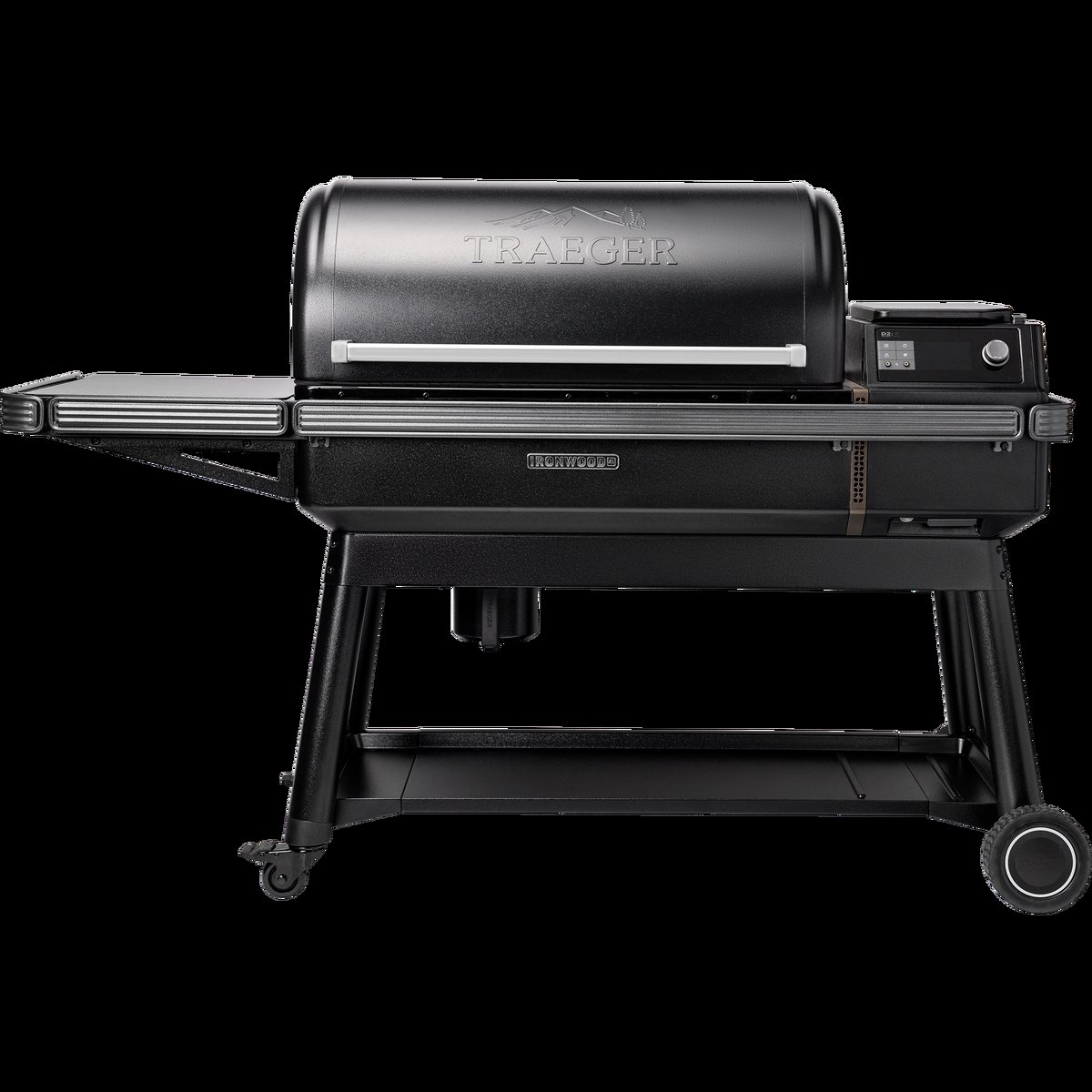
Traeger Ironwood XL
The Ironwood XL is the standard Ironwood stretched from 616 to 924 sq in; controller, touchscreen, sealed chamber, pellet sensor and grease keg are all identical. Against the Timberline above it, it gives up the third rack, the induction side cooktop and the stainless build for $1,500. Against the Woodridge Elite at the same money, it trades the gas burner for the touchscreen controller and the better-sealed chamber.

Traeger
Traeger Ironwood
The current-generation Ironwood replaced the discontinued Ironwood 885 in Traeger's lineup, trading raw cooking area for a dual-wall insulated barrel, a color touchscreen, and Smart Combustion tech that owners consistently say holds temps within a few degrees even in wind and cold. The EZ-Clean ash keg is the sleeper feature — cleanup drops from a shop-vac session to emptying a bucket. The honest knocks: at $1,800 you're paying a steep premium over a Woodridge Pro that cooks nearly as well with more space, the 500F ceiling still won't sear like a gas grill or a Weber Searwood's 600F, and Traeger's smoke profile stays on the mild side unless you lean on Super Smoke and 225F cooks. Some owners report WiFIRE connectivity drops and occasional startup temp overshoot, and the induction fan is audible. But as a set-and-forget smoker with genuinely modern controls and a 10-year warranty, it's the best-sorted mid-size Traeger yet — just know you're paying for polish, not capacity.
Traeger
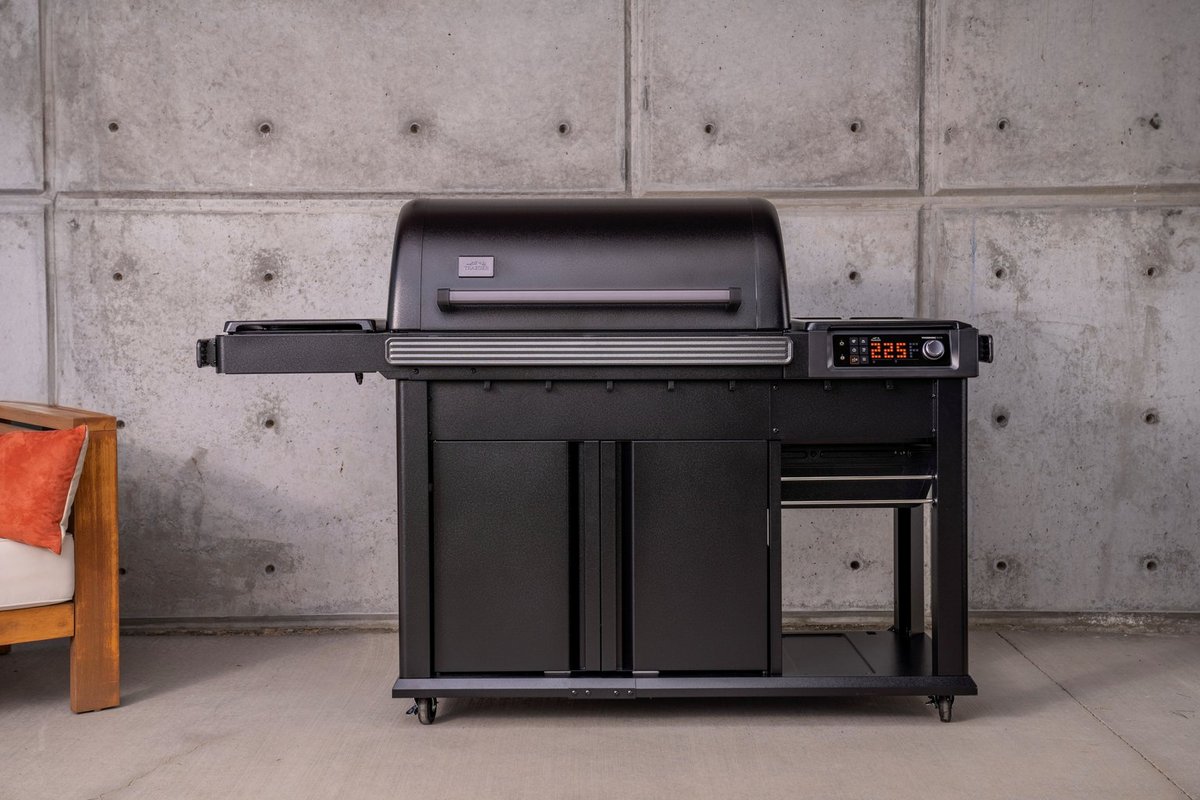
Traeger Woodridge Elite
The top of the Woodridge family and the only one with a gas side burner. Chamber, hopper and controller are identical to the Woodridge Pro Plus — 970 sq in across two racks, 24 lb hopper, 500°F ceiling — so the entire $400 step up buys the burner plus the enclosed cabinet. It sits at the same $1,800 as the Ironwood, which trades the burner for a touchscreen, pellet sensor and a sealed chamber.

Traeger
Traeger Ironwood 885
The Traeger Ironwood 885 is a WiFi-connected wood-pellet grill and smoker from Traeger, the company that popularized pellet grills. It uses the D2 direct-drive controller and WiFIRE app for hands-off cooks. Traeger has moved it to its Legacy Grills line — still sold new on traeger.com, but the current equivalent is the Ironwood XL.
Traeger
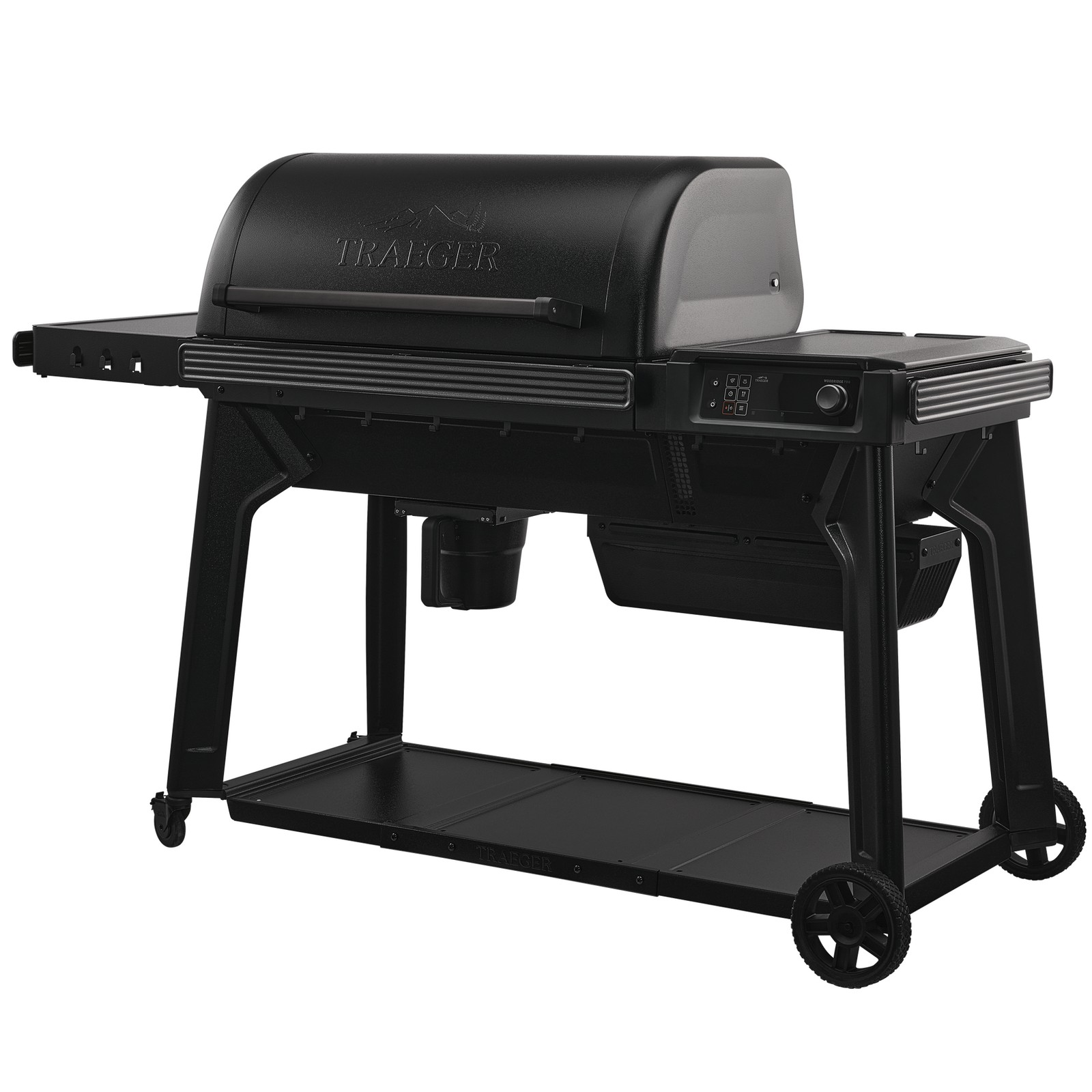
Traeger Woodridge Pro
The Traeger Woodridge Pro is the 2025 replacement for the aging Pro series - 970 sq in, a 24 lb hopper with pellet sensor, Super Smoke mode, and a 10-year warranty at $1,000. Reviewers call it the biggest upgrade to Traeger's entry lineup in years.