Weber
Weber Traveler
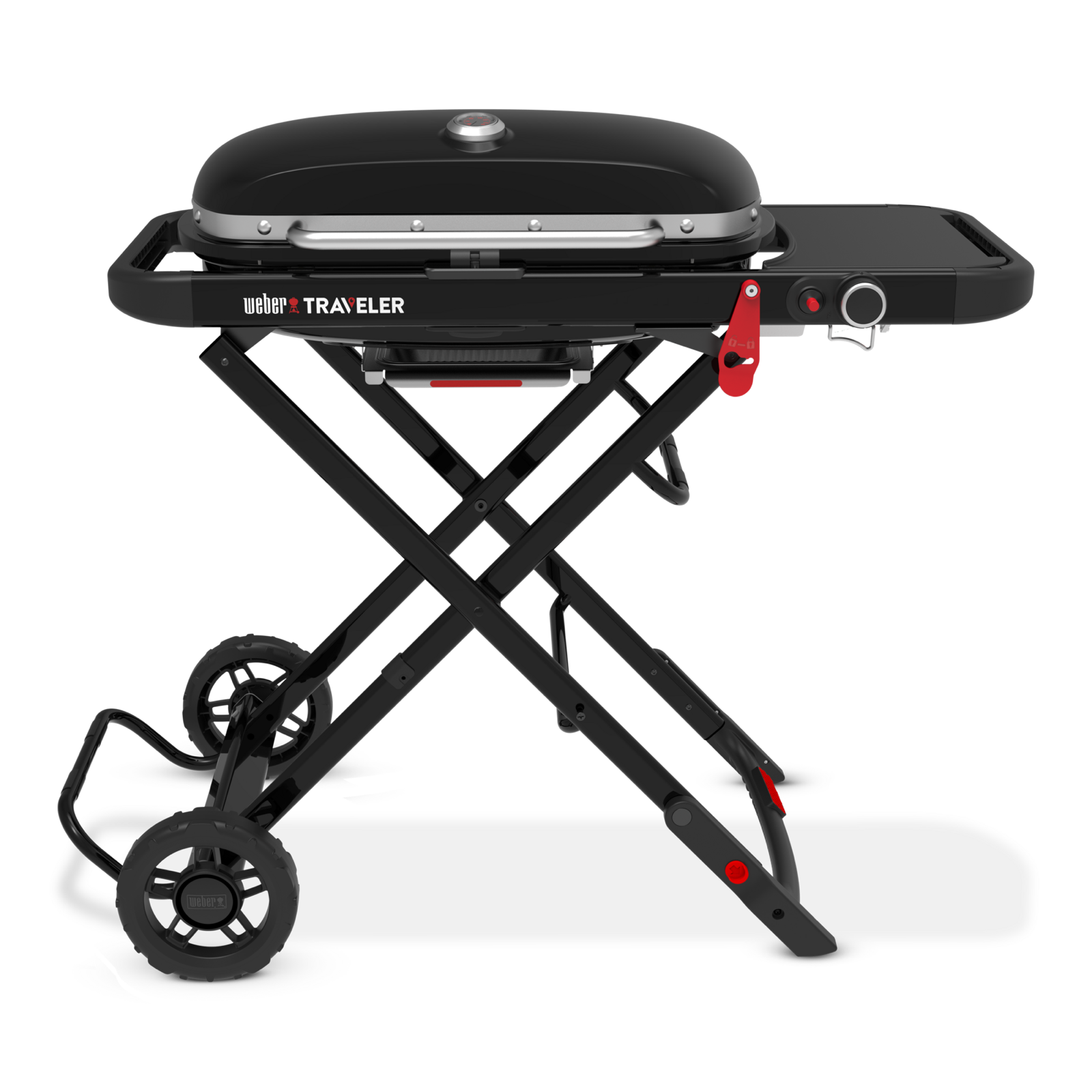
A full-size portable: 320 sq in of cast-iron grate on a folding cart that collapses in one motion and rolls on two wheels like a hand truck. That is roughly the grilling area of a Weber Spirit compacted into something that fits a car trunk, which is what separates it from the tabletop Q series. Single 13,000 BTU burner, so it trades heat output for footprint. A Traveler Compact and an RV-specific version are also sold.
Goes to the manufacturer. We earn nothing on this one.
Specifications
Pros
- ✓320 sq in is roughly double the grate area of most tabletop portables
- ✓Folds and rolls upright on its own wheels, so it does not need lifting into a vehicle
- ✓Porcelain-enameled cast-iron grate rather than the thin wire grate typical of portables
- ✓Runs on a 1 lb canister or, with the adapter, a 20 lb tank
- ✓Stable stand built in — no table required, unlike the Q series without its cart
Cons
- ✗13,000 BTU over 320 sq in is low heat density; it is slow to preheat and slow to recover
- ✗Single burner means no true two-zone cooking
- ✗49 lbs is heavy for a portable — fine to roll, awkward to lift into a truck bed alone
- ✗5-year cookbox warranty, half the Spirit line's coverage
- ✗Only 61 reviews on Weber's store; the rating is thin for a model this widely sold
Owner Insightssummarized from owner discussions
The Weber Traveler is the portable that people buy after handling it. The most common purchase story in owner discussions is someone who went in intending to buy a Coleman, opened and closed a Traveler at the store, and changed their mind about the price on the spot. What they are paying for is a fold-flat cart mechanism that feels engineered rather than folded sheet metal, and a cooking surface big enough to be a real grill rather than a camp accessory.
In use, the thing owners note most is that it stops being the travel grill. A recurring pattern is buying it for camping or tailgating and then using it at home regularly, which is the practical signal that the cooking is not compromised by the format. The maintenance quirks are small: burner ports clog after cleaning or a rain soak, and owners clear them by poking them through. Cleaning it properly while away from home is the genuinely unsolved problem, and owners trade half-answers about it.
It suits campers, tailgaters, RV owners and anyone whose grilling space has to disappear afterwards, and there is a dedicated RV version with a hose for an onboard supply that is easy to miss when shopping. The honest hesitation is price — around $400 buys a lot of stationary grill, and owners cross-shopping the Q series or Napoleon's TravelQ are usually deciding whether portability is worth that premium. Those who bought it rarely regret it; those still deciding are almost always stuck on the number.
What owners like
- +The fold-and-roll design is what sells it — owners who handled it next to the competition in a store repeatedly describe deciding on the spot because the mechanism feels solid rather than flimsy
- +It is compared directly against Coleman's portables and wins on build quality in almost every one of those threads, with owners describing the Coleman units as noticeably less substantial
- +Plenty of owners buy it as a second grill and then use it at home more than they expected, which is the recurring sign that the cooking is not a compromise
- +One cooking surface at a usable size, rather than the small round grate most portables give you — owners cross-shopping the Q series pick the Traveler specifically when they want space
- +There is an RV variant that ships with a hose to connect to an onboard propane supply, which owners with fifth wheels point out is the version they actually wanted
- +Burner ports that clog from cleaning or rain are cleared by poking them out, a fix owners describe as routine rather than a repair
Common complaints
- −At around $400 it is expensive for a portable, and the price is the main thing that gives buyers pause — several describe sitting on the fence for months
- −Cleaning it away from home is an open question owners ask each other about without a satisfying answer, since there is no tidy solution on the road
- −Running it off anything other than the intended supply invites trouble — owners asking about angled butane canisters and external regulator conversions get cautious answers
- −At least one owner has reported a fire incident with no damage beyond the grill itself, which is worth knowing even though it appears isolated
Common Questions
How does it compare to the Coleman portables?
Is there a version for an RV?
Can I use a butane canister or an external regulator with it?
How do you clean it when you are away from home?
Should I get the Traveler or a Weber Q?
Compare the Weber Traveler
Related grills
More from Weber →
Weber
Weber Spirit E-210
The Spirit E-210 is the compact half of Weber's best-selling gas grill family - the current Snap-Jet generation of the 2-burner that thousands of small-patio owners have run for decades. The formula hasn't changed because it works: a porcelain-enameled cookbox that won't rust through (and is warrantied for 10 years against it), cast iron grates, Flavorizer bars that turn drippings into flavor instead of flare-ups, and burners that light on the first click years in. At 48 inches wide it fits patios and townhome decks where even the 3-burner E-310 feels bulky, and the 2025 refresh added per-burner Snap-Jet ignition and Weber Works rails for accessories. The honest limits: 26,600 BTU across two burners means preheating takes a while, a hard steakhouse sear takes patience, and two burners make real indirect cooking cramped - a whole chicken works, a brisket doesn't. Owners also note the current generation's lid can drip rainwater into the grease tray if stored uncovered. Against value rivals like the Char-Broil Performance, you pay roughly double up front and get a grill that routinely outlives three of them; used Spirits famously hold resale value.

Weber
Weber Spirit E-310
The Weber Spirit E-310 is a compact 3-burner propane gas grill and one of the best-selling backyard grills in America. The latest redesign adds Snap-Jet ignition and a more modern cart.
Weber
Weber Q 2800N+
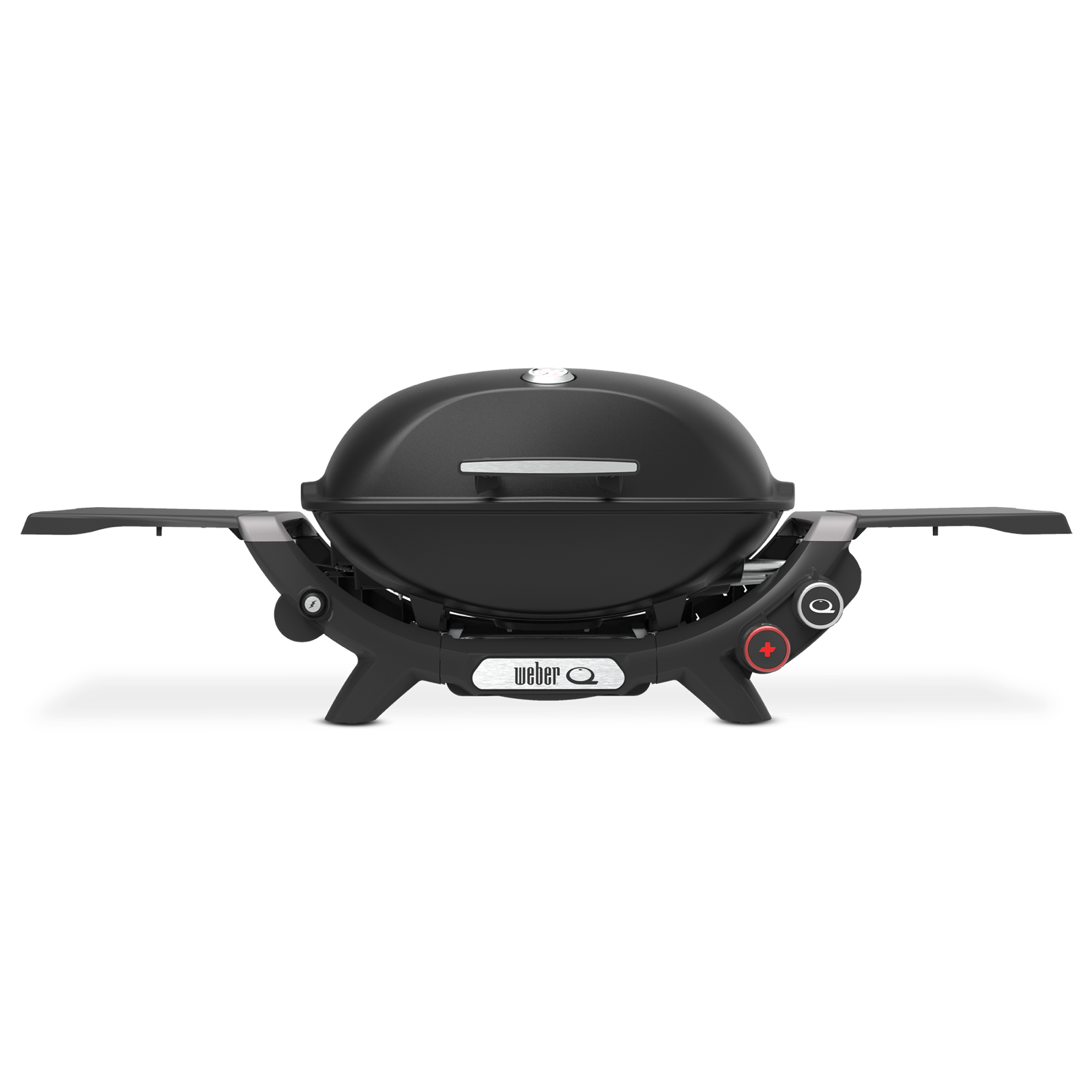
The grill that replaced the Q 2200 in Weber's US lineup and is now effectively the whole Q series here. Against the old Q 2200 it adds 14% more grate area (320 vs 280 sq in) and 50% more heat (18,000 vs 12,000 BTU), plus a separate 4,000 BTU "Plus" burner that lets the dome hold a genuine 250°F for roasting. Priced as the tabletop unit; the rolling stand is a separate $129.99 accessory, or $599 bundled.
Weber
Weber Spirit E-325
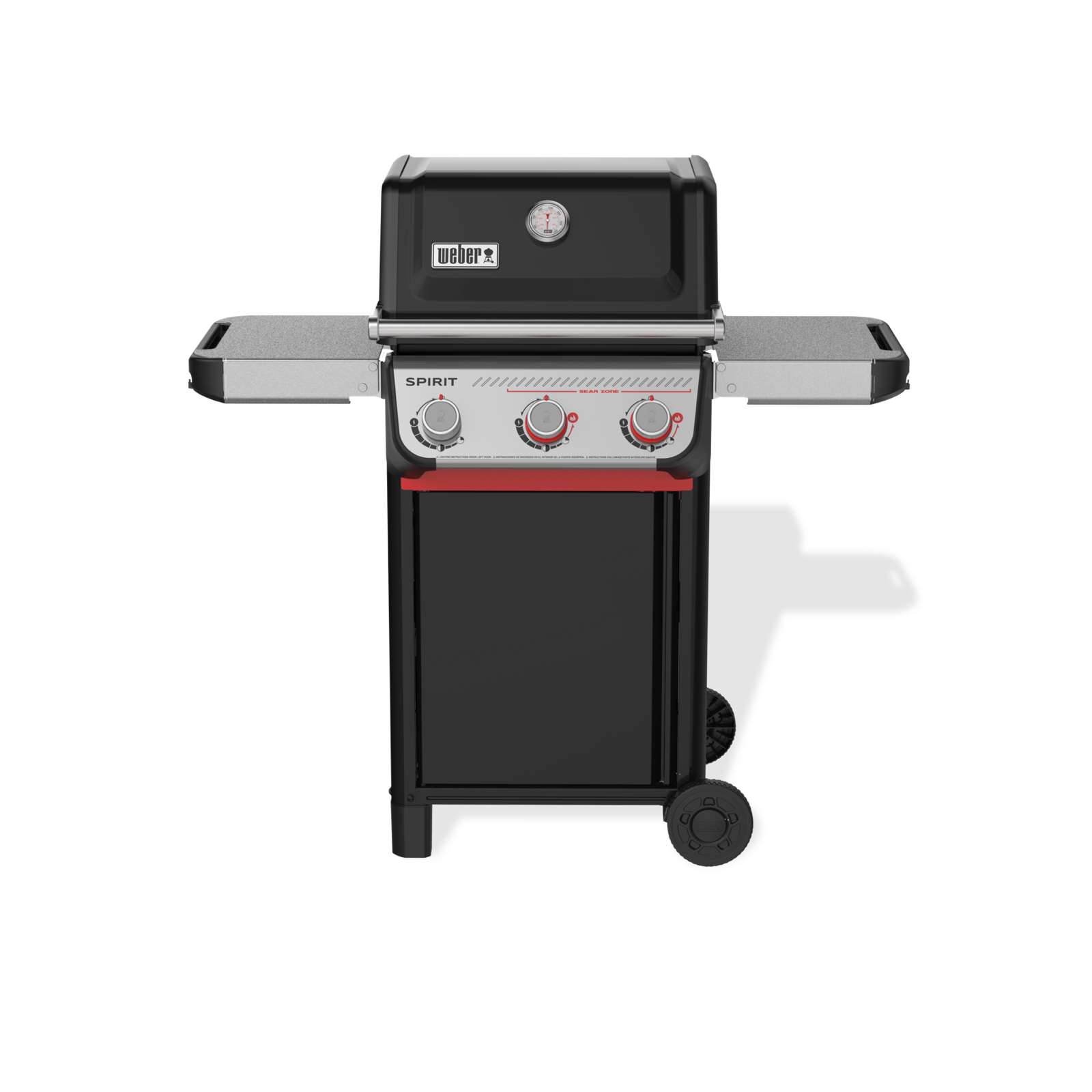
The top of Weber's non-smart Spirit line and the model directly above the Spirit E-310 already in this catalog. It adds a Sear Zone — two Boost Burners that concentrate roughly 40% more power over one section of the grate — on the same 360 sq in primary grate as the current E-310. Priced as the LP version in black; natural gas runs $549.
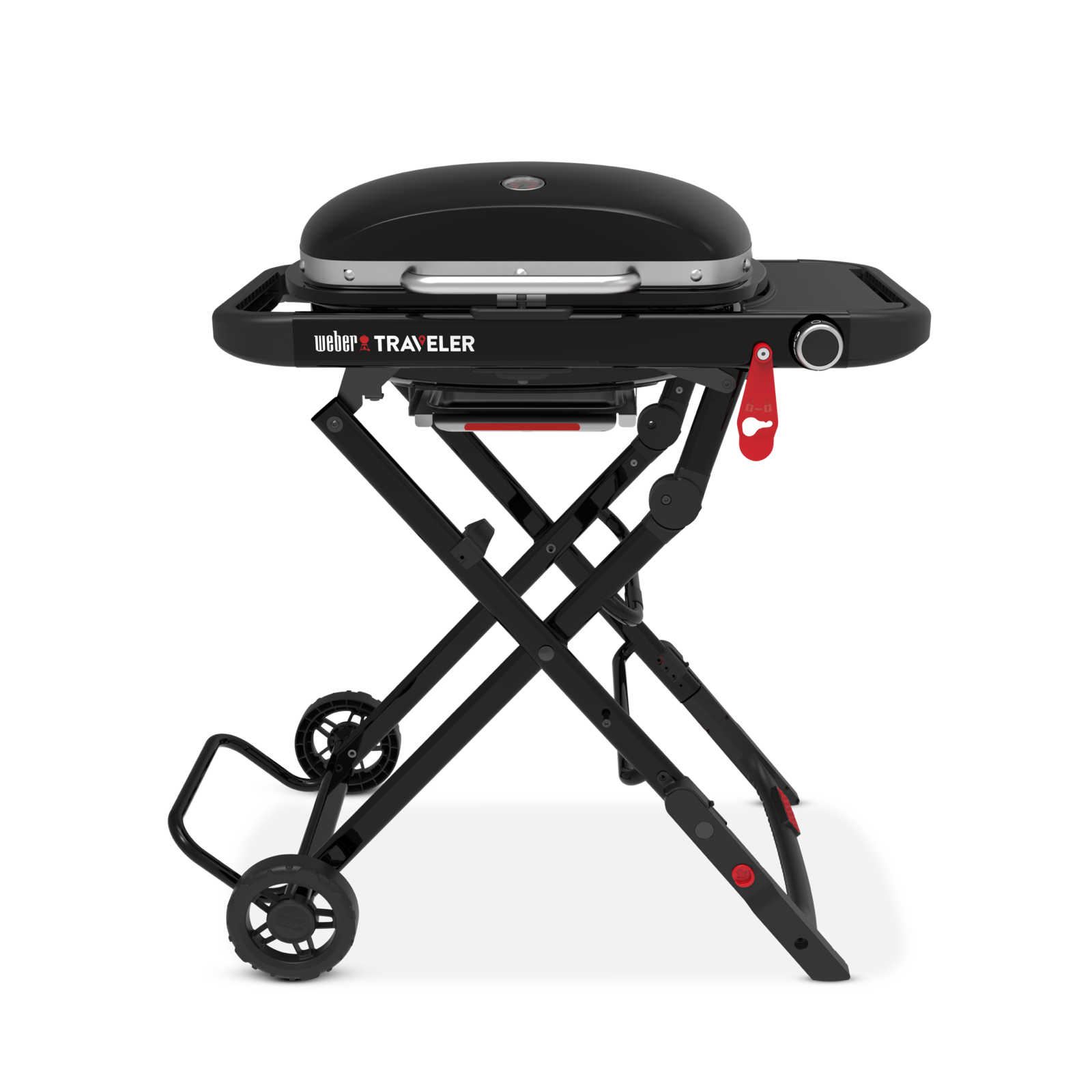
The Traveler shrunk by about a fifth: 240 sq in, 11,000 BTU, 37 lbs and 34 inches wide folded, which is the difference between fitting in a compact car trunk and not. Same folding-cart mechanism and same warranty as the full Traveler. It also uses split cooking grates, so one half can be swapped for a griddle insert.

Weber
Weber Q 1200
The Q 1200 has been the default answer to 'best portable gas grill' for over a decade, and the review volume backs it up - it's one of the most-reviewed grills Weber sells. Unlike the thin folding camp grills it competes with, the Q is a real grill shrunk down: a cast aluminum cookbox that retains heat like a full-size Weber and porcelain-enameled cast iron grates that lay down legitimate sear marks on steaks and burgers. OutdoorGearLab has ranked it their top tabletop portable for years, and owner threads about balcony and tailgate setups almost always land here. Honest limitations: one U-shaped burner means no two-zone cooking, so thick cuts and bone-in chicken take lid management and patience; 189 sq in feeds about four people; it drinks 1 lb canisters, so most owners buy the adapter hose for a 20 lb tank; and the low-profile grease tray will flare if you never clean it. The regulator's low-flow safety lockout (weak flames after a bottle swap) is the most common owner complaint, fixable with the well-known reset ritual. Against a Blackstone 22 you're trading griddle versatility for real grill marks and a lid.