
Weber
Weber Spirit E-310
The Weber Spirit E-310 is a compact 3-burner propane gas grill and one of the best-selling backyard grills in America. The latest redesign adds Snap-Jet ignition and a more modern cart.
We may earn a commission. Price and availability on Amazon may differ.
Specifications
Pros
- ✓It's the gold-standard everyday gas grill - dead reliable, even-heating, and the burners light first try year after year
- ✓Weber's build quality and 10-year warranty mean it routinely outlasts cheaper grills by a decade or more
- ✓Three burners over 360 sq in (450 with the warming rack) are perfectly sized for a family of four to six without hogging patio space
- ✓Porcelain cast-iron grates and Flavorizer bars give excellent sear marks and cut down flare-ups by funneling grease away
- ✓The new Snap-Jet individual burner ignition is fast and far more reliable than the old single-spark systems
- ✓Its compact footprint fits small patios and balconies where a bulky 4-burner wouldn't
- ✓Resale value is famously strong - used Spirits hold their price because buyers trust the brand
- ✓Parts are universally available, so you can keep one running essentially forever with cheap replacement grates and bars
Cons
- ✗At 24,000 BTU it's not the hottest grill, and getting a true high-heat steak sear takes patience and preheating
- ✗360 sq in of primary grate is on the small side, so cooking for a big group means working in batches
- ✗There's no side burner on the E-310, so sauces and sides still mean a trip back to the kitchen
- ✗No smart features, probe, or app - it's a purely manual grill, which feels basic at the latest price
- ✗The redesigned model swapped some stainless components for coated steel, which purists view as cost-cutting
- ✗Side tables are useful but small, and there's no enclosed storage for the propane tank
- ✗Price has crept up to ~$550, narrowing the gap with larger grills from budget brands
- ✗It only does gas grilling - no low-and-slow smoking capability without aftermarket workarounds
Owner Insightssummarized from owner discussions
The Spirit E-310 is the three-burner gas grill that most American backyards default to, and the thing owners praise is not the cooking — it is the longevity and the repairability. These threads are full of people running Spirits that are eight, eleven, even twenty years old, and of people who picked one up off the curb or for $100 on marketplace, spent about $50 on flavorizer bars and an igniter, and put it straight back into weekly service. That is the real case for paying roughly double what a Char-Broil costs: not that it cooks better on day one, but that it is still cooking in year twelve and every part is still available.
Where it disappoints people is heat. A striking number of owners report that they cannot get browning on a burger or a proper crust on a steak even after a long preheat with all three burners wide open, and one long-time owner is upgrading to a Genesis for exactly that reason. It is not universal — other owners say theirs runs past 700°F and sears fine — and there are two concrete explanations worth checking before blaming the grill. Spider webs in the burner venturi tubes cap output on grills that have sat unused, which Weber has documented and an $8 brush fixes. And the natural gas version genuinely produces less heat than the propane one, to the point that one owner's hardline grill will not hold past 350°F wide open. Beyond heat, the wear items are predictable: porcelain chips off the cast iron grates within a season or two and they eventually rust through, igniters die, and the cart and rear panel are usually what finally kills an old one. It does hold low temperatures well, which owners take advantage of with a smoke box for a few hours of indirect cooking.
It suits someone who wants a grill they will still own in a decade and who does most of their cooking on weeknights — burgers, chicken, brats, things that do not live or die on a steakhouse crust. If a hard sear is your priority, owners point you at a Genesis with a dedicated sear burner, at a Napoleon, or at simply keeping a charcoal kettle alongside it, which is what most of the people in these discussions actually do. The honest caveats are that the model names are a mess — the enclosed E-310, the Spirit II E-310 and the E-315 differ more in warranty than in cooking area — and that you should buy the fuel version matching your hookup, because converting it is no longer supported.
What owners like
- +It lasts long enough that the used market is its own argument. Owners are still running 8-, 11- and 20-year-old Spirits, and people routinely pull them off the curb or out of a marketplace listing and bring them back with about $50 of parts
- +Parts are the reason those restorations work. Flavorizer bars are roughly $25 and swap directly, burners, grates and regulators are all stocked, and one owner with rusted-through burners had replacements shipped fast under warranty
- +It holds low temperatures steadily for hours, which owners exploit with a smoke box for indirect ribs — more than you would expect from a three-burner gas grill
- +The accessory system is genuinely useful: a carbon steel griddle insert, GrillGrates, a pizza stone and a cross-hatch sear grate all drop into the same cutout, so one grill covers griddle and grate duty on a deck with room for only one
- +It is the grill people actually use on a weeknight. Even committed charcoal owners in these threads concede they grill several times more often since adding a gas grill, because dinner is on in minutes with nothing to light and no ash to deal with
- +The enclosed cart hides the propane tank, which is the main reason owners choose the E-310 over the otherwise identical Spirit II E-310
Common complaints
- −Searing is the recurring disappointment. Owners describe preheating past 500°F and still getting no browning on burgers, barely visible flame at full output, and one multi-year owner shopping a Genesis specifically because three burners on maximum will not sear a steak properly. Others get over 700°F out of theirs, so it is not universal — but it is common enough that you should expect to test yours
- −A big share of the 'won't get hot' cases trace to spider webs blocking the burner venturi tubes, a problem Weber has documented on grills that sit unused. It is an $8 brush to fix, but nothing tells you that is what happened
- −Buying the natural gas version off a hardline is a real trap. Natural gas carries far less energy per unit than propane, and one owner's new natural gas E-310 struggles to hold 350°F with all three burners wide open. Weber no longer sells a conversion kit, so the fuel type you buy is the one you keep
- −The porcelain enamel on the cast iron grates chips after about a season, and once it does you cannot sand and re-season them the way you would bare cast iron. Owners report grates eventually rusting through and breaking
- −Ignition is not the sure thing it is supposed to be. Dead igniters are the most common fault on used units, and one owner of a new grill describes fighting it every single time and refusing to use the match holder underneath
- −Warranty service can turn into paid guesswork. One owner with a three-year-old grill was walked through a new tank, a regulator reset, then a $30 replacement regulator and hose, and when none of it worked was quoted $130 for a manifold assembly with no diagnosis behind it
- −The lineup is genuinely confusing and the warranties differ. The enclosed E-310 and the open-cart Spirit II E-310 have the same 424 sq in, but the Spirit II carries 10 years across the board while the enclosed version drops grates and bars to five. The late-2024 refresh also shrank the comparable model to 360 sq in, which owners noticed and disliked
- −Rust eventually takes the parts nobody covers. Owners report bottom cabinets, base panels and rear panels rusting out, and replacement stock for those pieces running thin
Common Questions
Why can't I get a sear or any browning on burgers?
Spirit E-310 or Spirit II E-310?
Can I hook it up to my house natural gas line?
Are the porcelain-coated cast iron grates worth keeping?
Is a used Spirit worth buying, and what should I check?
Should I step up to a Genesis instead?
Compare the Weber Spirit E-310
The Weber Spirit E-310 is one of 4 sizes in this line.
See every size, to scale →Related grills
More from Weber →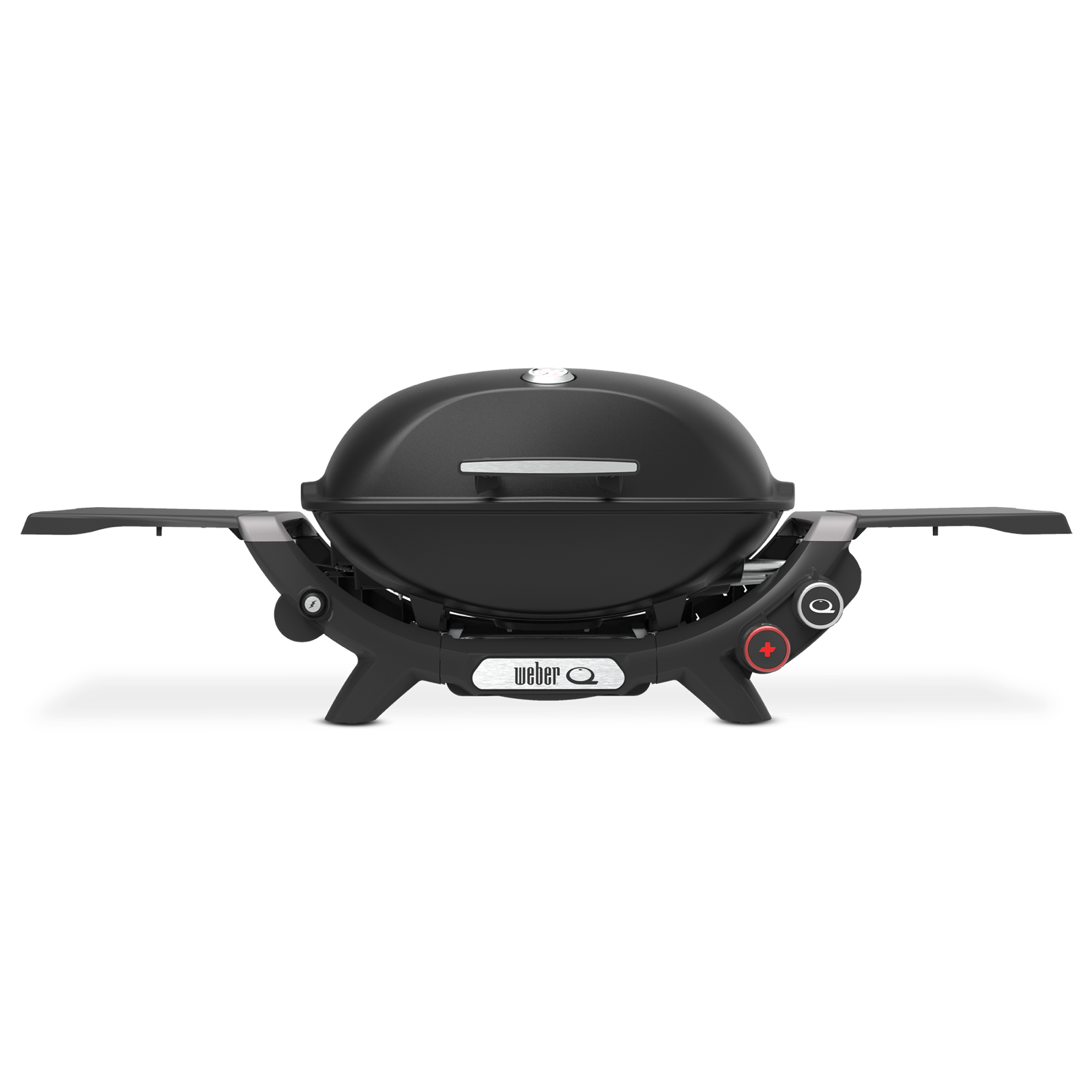
Weber
Weber Q 2800N+
The grill that replaced the Q 2200 in Weber's US lineup and is now effectively the whole Q series here. Against the old Q 2200 it adds 14% more grate area (320 vs 280 sq in) and 50% more heat (18,000 vs 12,000 BTU), plus a separate 4,000 BTU "Plus" burner that lets the dome hold a genuine 250°F for roasting. Priced as the tabletop unit; the rolling stand is a separate $129.99 accessory, or $599 bundled.

Weber
Weber Spirit E-210
The Spirit E-210 is the compact half of Weber's best-selling gas grill family - the current Snap-Jet generation of the 2-burner that thousands of small-patio owners have run for decades. The formula hasn't changed because it works: a porcelain-enameled cookbox that won't rust through (and is warrantied for 10 years against it), cast iron grates, Flavorizer bars that turn drippings into flavor instead of flare-ups, and burners that light on the first click years in. At 48 inches wide it fits patios and townhome decks where even the 3-burner E-310 feels bulky, and the 2025 refresh added per-burner Snap-Jet ignition and Weber Works rails for accessories. The honest limits: 26,600 BTU across two burners means preheating takes a while, a hard steakhouse sear takes patience, and two burners make real indirect cooking cramped - a whole chicken works, a brisket doesn't. Owners also note the current generation's lid can drip rainwater into the grease tray if stored uncovered. Against value rivals like the Char-Broil Performance, you pay roughly double up front and get a grill that routinely outlives three of them; used Spirits famously hold resale value.
Weber
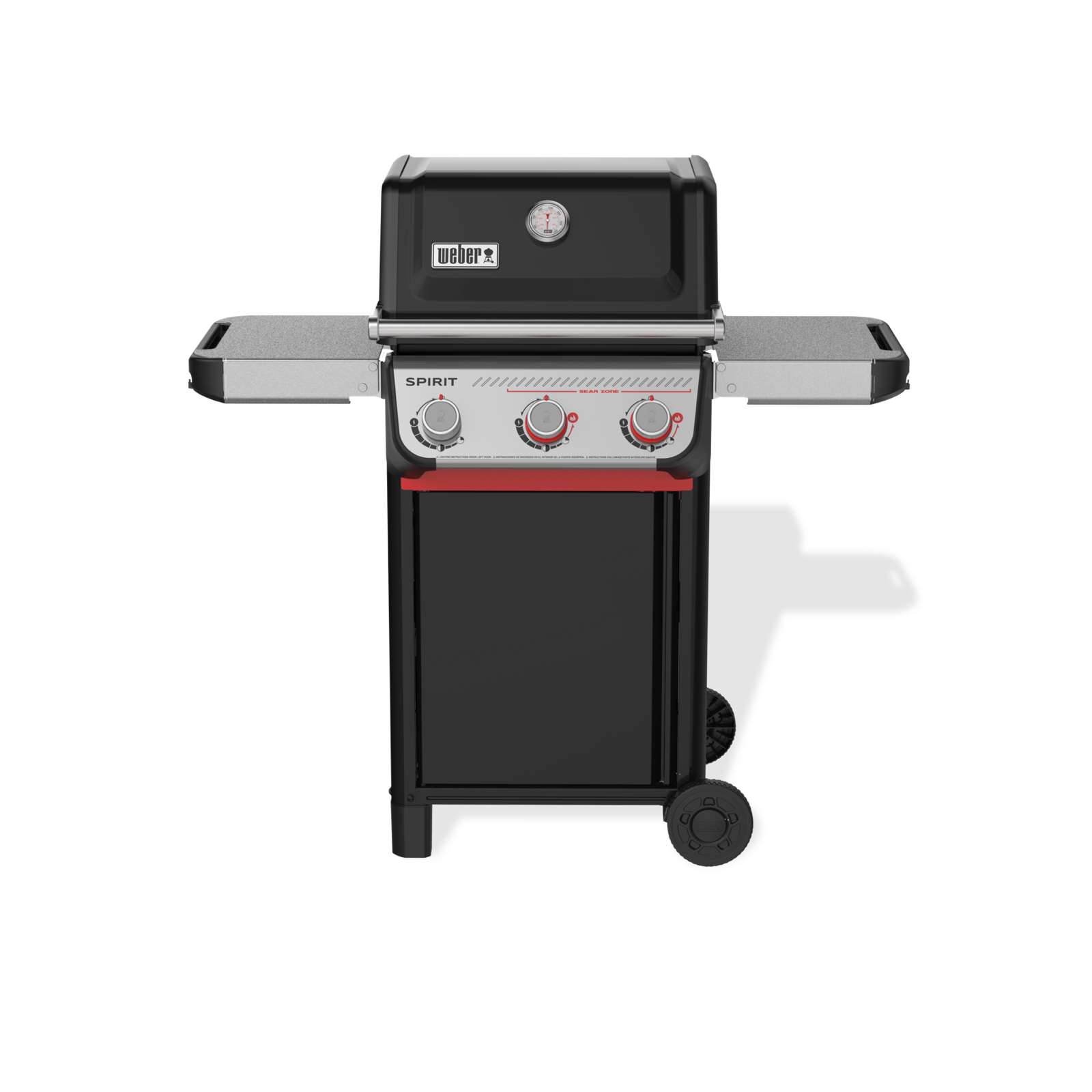
Weber Spirit E-325
The top of Weber's non-smart Spirit line and the model directly above the Spirit E-310 already in this catalog. It adds a Sear Zone — two Boost Burners that concentrate roughly 40% more power over one section of the grate — on the same 360 sq in primary grate as the current E-310. Priced as the LP version in black; natural gas runs $549.
Weber
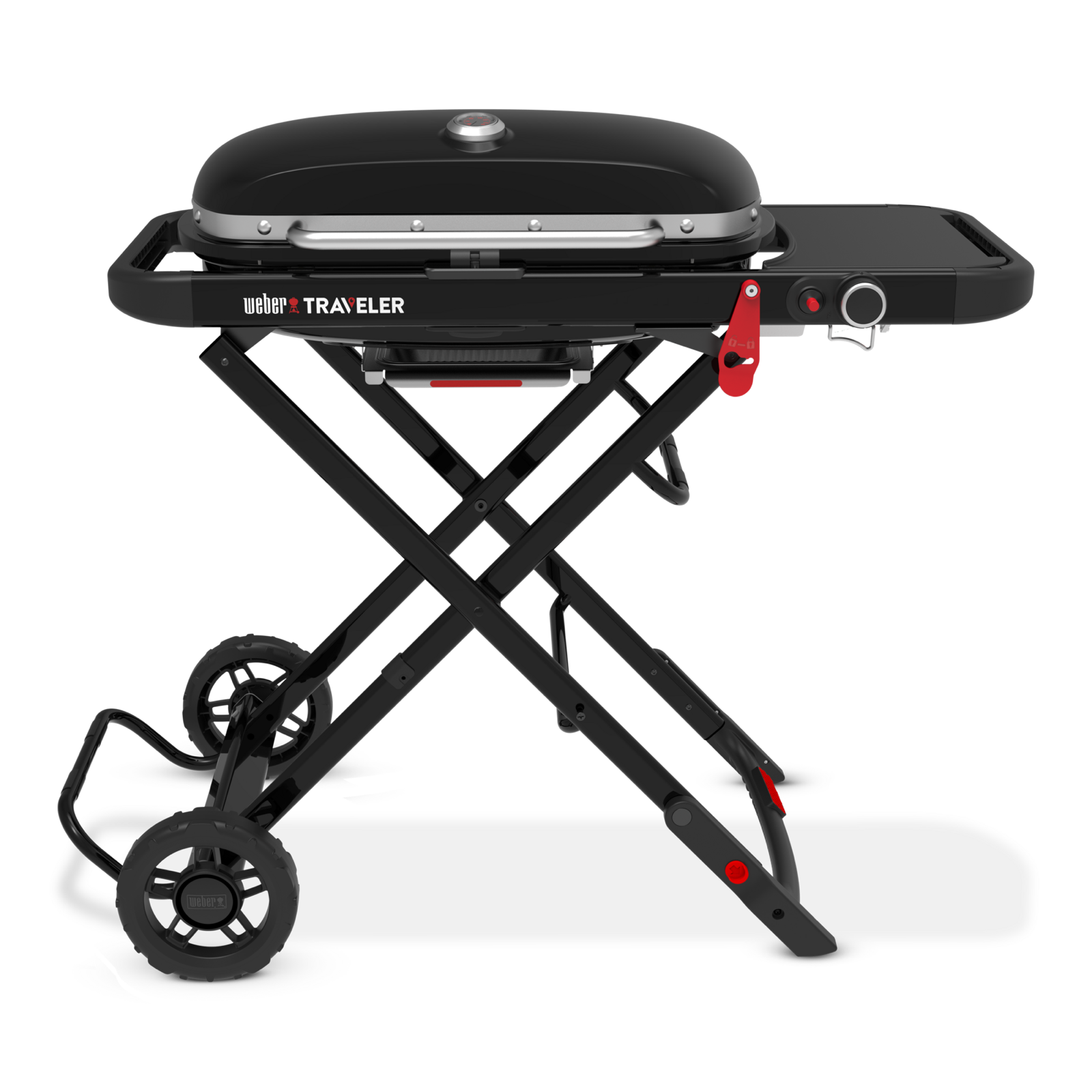
Weber Traveler
A full-size portable: 320 sq in of cast-iron grate on a folding cart that collapses in one motion and rolls on two wheels like a hand truck. That is roughly the grilling area of a Weber Spirit compacted into something that fits a car trunk, which is what separates it from the tabletop Q series. Single 13,000 BTU burner, so it trades heat output for footprint. A Traveler Compact and an RV-specific version are also sold.
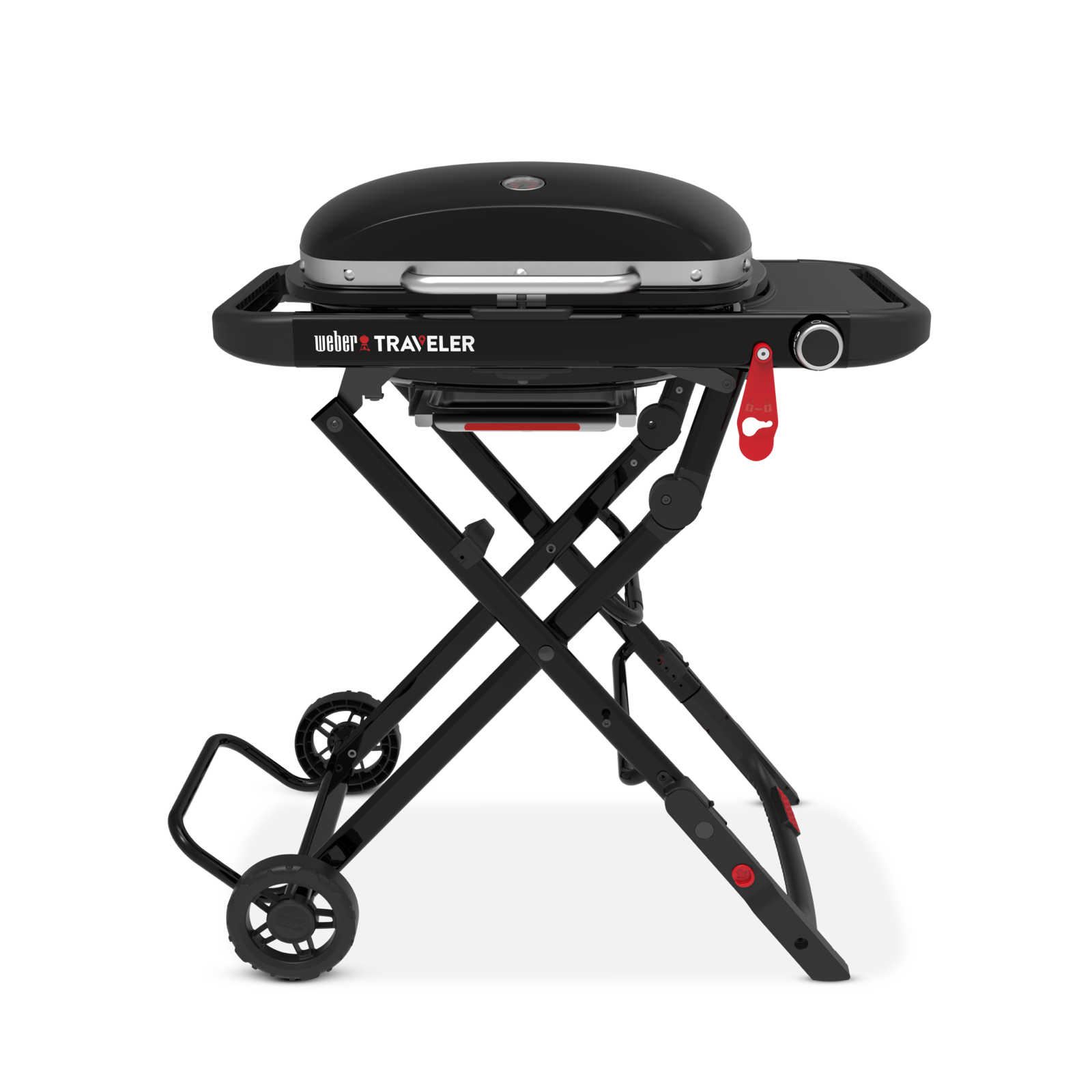
The Traveler shrunk by about a fifth: 240 sq in, 11,000 BTU, 37 lbs and 34 inches wide folded, which is the difference between fitting in a compact car trunk and not. Same folding-cart mechanism and same warranty as the full Traveler. It also uses split cooking grates, so one half can be swapped for a griddle insert.

Weber
Weber Q 1200
The Q 1200 has been the default answer to 'best portable gas grill' for over a decade, and the review volume backs it up - it's one of the most-reviewed grills Weber sells. Unlike the thin folding camp grills it competes with, the Q is a real grill shrunk down: a cast aluminum cookbox that retains heat like a full-size Weber and porcelain-enameled cast iron grates that lay down legitimate sear marks on steaks and burgers. OutdoorGearLab has ranked it their top tabletop portable for years, and owner threads about balcony and tailgate setups almost always land here. Honest limitations: one U-shaped burner means no two-zone cooking, so thick cuts and bone-in chicken take lid management and patience; 189 sq in feeds about four people; it drinks 1 lb canisters, so most owners buy the adapter hose for a 20 lb tank; and the low-profile grease tray will flare if you never clean it. The regulator's low-flow safety lockout (weak flames after a bottle swap) is the most common owner complaint, fixable with the well-known reset ritual. Against a Blackstone 22 you're trading griddle versatility for real grill marks and a lid.