
Pit Boss
Pit Boss Pro Series 1150
The Pit Boss Pro Series 1150 is a value-focused WiFi pellet grill sold through Lowe's, featuring a sliding Flame Broiler plate for direct-flame searing and a digital PID controller. Pit Boss is owned by Dansons. Note: this model is no longer sold new as of 2026. Its current equivalent is the Pit Boss Pro Series V3 1150. (Original Pro Series 1150 replaced by V2 (10576) then V3 (10980/PB1150PS3) at Lowe's; V3 sells ~$699)
Specifications
Features
Pros
- ✓You get a massive 1150 sq in of cooking space for around $700, by far the most square inches per dollar of any name-brand pellet grill
- ✓The sliding Flame Broiler plate exposes direct flame for searing up to ~1000°F, so it actually sears steaks better than most pellet grills
- ✓The 32 lb hopper is large enough for long overnight cooks without refilling
- ✓It comes with two meat probes included, which is more generous than Traeger's single probe at this price
- ✓The 5-year warranty is excellent for a budget grill and beats Traeger's 3 years
- ✓Porcelain-coated cast-iron grates hold heat well and leave nice sear marks
- ✓The removable ash and grease management makes cleanup between cooks quick and tidy
- ✓It heats up fast and the wide temp range covers everything from 180°F smoking to high-heat grilling
Cons
- ✗Temperature swings are wider than premium grills - expect 25-40°F fluctuations, so it's less precise for delicate low-and-slow cooks
- ✗Build quality is noticeably thinner powder-coated steel that can rust and warp, and fit-and-finish feels budget
- ✗The WiFi and Pit Boss app are the weak point - buggy, slow to connect, and prone to dropping the grill
- ✗Smoke output is lighter than Traeger's, so some owners add a smoke tube to get the bark and ring they want
- ✗Single-wall body loses heat in cold weather and burns through pellets quickly in winter
- ✗The controller and electronics are a common failure point, with owners reporting board replacements within a couple seasons
- ✗Customer service through Pit Boss/Dansons is hit-or-miss compared to Recteq's stellar reputation
- ✗It's heavy and bulky, and the casters can feel flimsy when rolling a fully loaded grill across rough patio surfaces
Owner Insightssummarized from owner discussions
The Pro Series 1150 is no longer sold — Pit Boss replaced it with a V2 and a V3 and then moved the whole line over to the Navigator and Sportsman names — but a lot of people own one, and its questions are still being asked. What it does well is the thing it was bought for: a large chamber at a low price that produces real barbecue. Owners run 13 lb briskets overnight, 14-hour pork butts unwrapped with heavy bark, and single loads of nearly 30 lb of meat, mostly within weeks of buying their first smoker.
What it does badly is hold an even, honest temperature. The complaint that defines this grill is side-to-side variation: one owner measured 425°F on the right and 325°F on the left with the grill stabilised at 350°F, and another living with 25 to 40°F of spread was told by the company that it is normal. Owners worked out part of the cause themselves, a gap where the curved deflector plate rests that shoots heat straight past the controller's probe, and the community fixes are foil in that gap, an aftermarket flame tamer over the fire pot, a stainless drip tray and a water pan. They work; one owner who did the full set reports under 5°F across the chamber. Separately the controller's reading drifts from reality, usually reading low against a wired thermometer, sometimes badly enough that owners have replaced the board four times without fixing it. The WiFi and app are worse still, with a firmware update that fails partway through on device after device, and with the app broken the grill loses functions like the timer entirely.
If you already own one, the path most owners take is to buy the aftermarket heat management parts, ignore the app, cook to an independent probe, and keep the grill clean; parts are cheap and everything on it is owner-serviceable. If you are looking at a used one, they turn up around $300 and that is a fair price for what it is, with the caveat that owners have had theirs rust out in three years and that the auger is a known failure point. Most of the people in these threads who moved on from one went to a Recteq, a Camp Chef or a Weber Searwood, usually citing temperature consistency as the thing they were buying.
What owners like
- +It puts out good food and owners get there fast. A cook four sessions into owning one ran a 13.3 lb brisket overnight at 225°F and was pleased with it; another ran two pork butts for 14 hours unattended and unwrapped; a third loaded 27.5 lb of venison and pork in one go. Capacity at this price is the reason people buy it and it delivers on that
- +It responds well to modification, and the fixes are cheap and known. Owners add an aftermarket flame tamer over the fire pot, a stainless drip tray and a heat baffle; one who did all three reports less than 5°F difference side to side after a 20-minute warm-up, which is better than the grill manages stock
- +Parts are available and owner-replaceable. Igniters, control boards, fire pots, exhaust caps and probes are all swapped by owners themselves, and an owner of the sibling 850 Pro who has run it outdoors in North Dakota for eight years has replaced exactly one part, a $15 igniter
- +The controller can be upgraded rather than replaced with a new grill. Pit Boss sells a WiFi and Bluetooth control board for around $100 that fits older units, and owners weigh it as a way to get three to five more years out of a grill that is otherwise cooking fine
- +They turn up cheap secondhand, which is now the most sensible way to buy one. Used examples in good condition appear in the $300 range, and given that the fixes for the grill's real faults are aftermarket parts anyway, that is a reasonable place to start
Common complaints
- −Side-to-side temperature difference is the defining complaint. One owner put thermometers in after stabilising at 350°F and measured 425°F on the right and 325°F on the left. Another, running the same model with a water pan over the fire pot, still sees 25 to 40°F across the chamber, and says Pit Boss told him it is normal and does not affect cooking
- −Owners traced part of it to the design: the curved deflector plate leaves a gap where it rests, and heat jets out of that gap right where the controller's temperature probe sits. Filling the gap with foil helps, and the aftermarket sells a metal piece to do the same job properly
- −The controller's reading and the real chamber temperature drift apart. A V3 owner with a wired thermometer found 300°F in the chamber with the grill set and reading 250°F. Another, three years in, measured actual temperatures 30 to 40°F below what the probe reported even after a deep clean. A third had his control board replaced four times, plus the internal thermometer, exhaust cap and fire pot, and it still read 75 to 100°F high
- −The app and the WiFi are the worst part of owning one. An owner returned his to Lowe's after an hour with support failed to get the mandatory update past 33 percent, then hit the identical failure on the replacement, across four phones and an iPad, a dedicated 2.4GHz network and a neighbour's network. Pit Boss eventually told him the problem was on their end, with the app not keeping up with iOS releases
- −Losing the app means losing the grill's controls. Owners report that with the app broken, temperatures stop updating and the timer cannot be set at all, and that the newer controller removed options the older one offered on the unit itself, including smoke mode. The advice owners give each other is to ignore the WiFi and buy good Bluetooth probes, since the onboard probes are not trusted anyway
- −Rust ends some of them. One owner's Pit Boss Pro rusted out in three years, badly enough that when the auger motor failed he replaced the grill rather than repair it
- −The auger is a known failure point. Owners report back-burning, and an auger that clanks and turns intermittently instead of continuously, which means pulling the grill apart to work out whether it is the auger or the motor
- −If you buy from Lowe's, do not accept it pre-assembled. Owner after owner describes assembled deliveries arriving with missing screws and washers, dents below the door glass, scratches and missing probes, handled by third-party assemblers; the compensation offered has ranged from a $40 gift card to a 15 percent refund, and the rule owners repeat is to take the boxed one
Common Questions
Why is one side of my grill so much hotter than the other?
Why does the display not match my own thermometer?
Is the WiFi controller upgrade worth $100?
What should I know before buying one from Lowe's?
Is it worth buying a used one now that it is discontinued?
Compare the Pit Boss Pro Series 1150
This model is no longer sold new. Its current equivalent is the Pit Boss Pro Series V3 1150.
We keep this page for the many still in use and on the used market — specs and honest pros/cons below still apply.
Related grills
More from Pit Boss →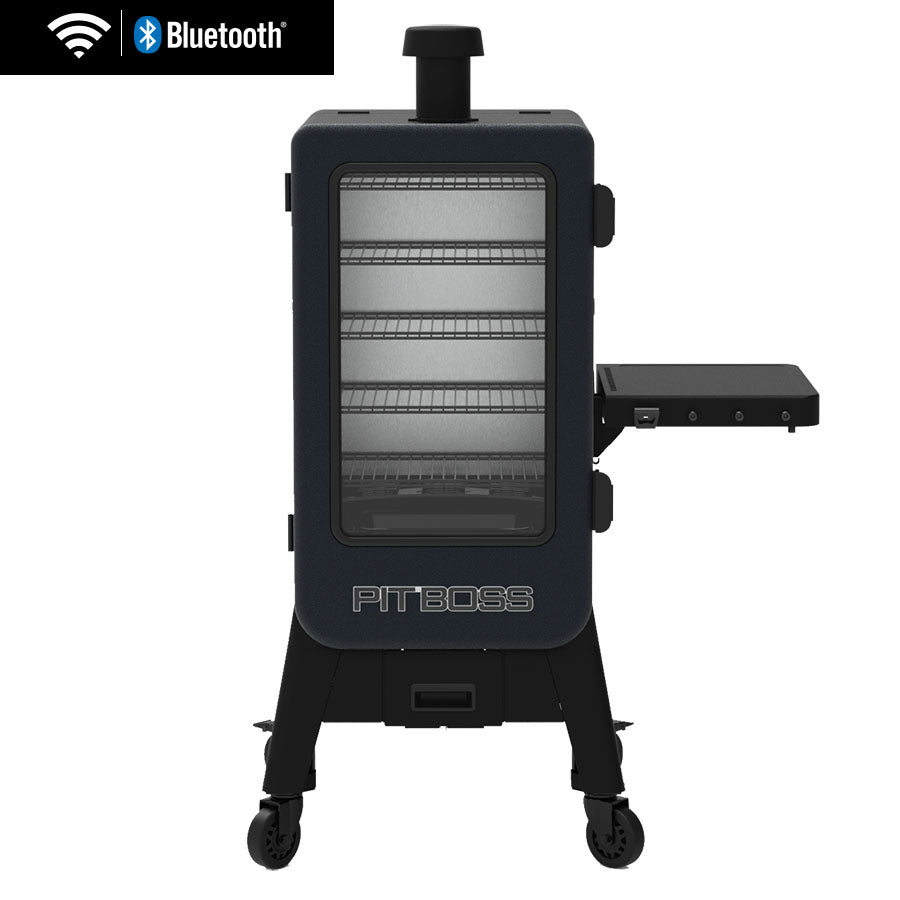
A vertical pellet cabinet, not a pellet grill with a lid — five racks stacked in an insulated cabinet with an auger-fed burn pot at the base and a chimney above, so heat and smoke rise past every rack in sequence. That is the opposite of a horizontal pellet grill, where a diffuser plate spreads heat sideways. This is Pit Boss's replacement for the Copperhead 3-Series name and carries a 50 lb hopper and WiFi.
Pit Boss
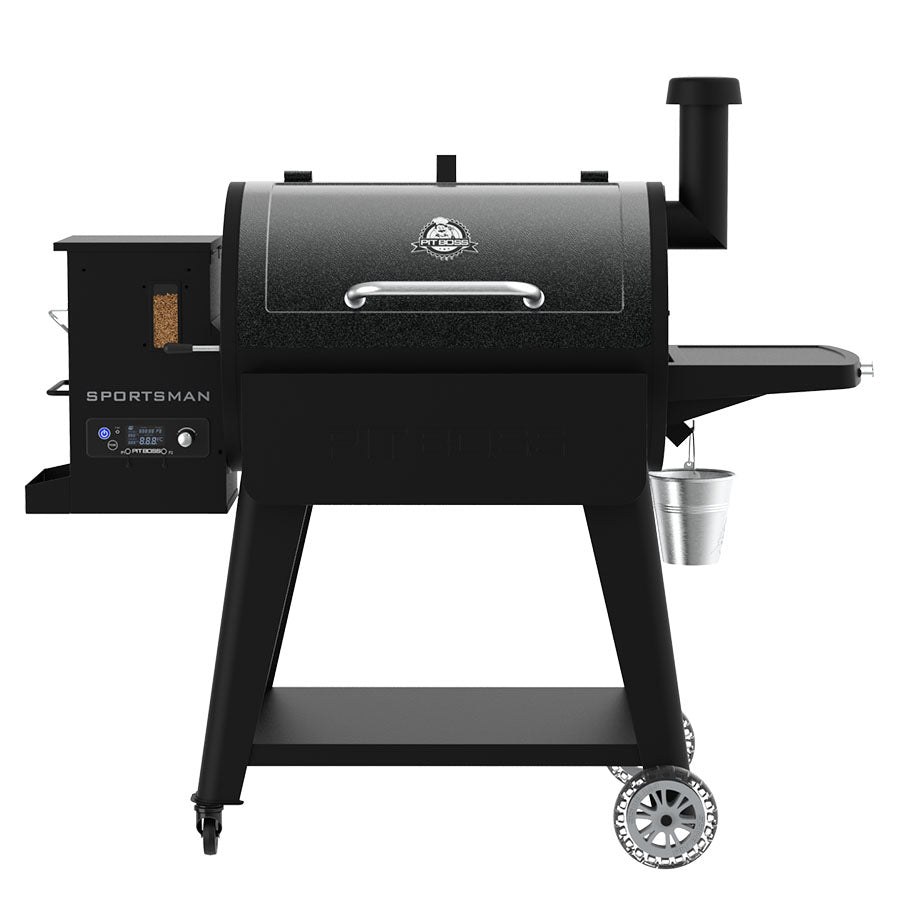
Pit Boss Sportsman 850
Sportsman is the hunting-and-outdoors trim of the Pit Boss line, and the 850 is its core size — 849 sq in, 21 lb hopper, WiFi and Bluetooth, one probe included. It adds connectivity and a hammertone finish over the FB2 700 below it while keeping the same 180–500°F range and the Flame Broiler lever for direct-flame searing. Against the Navigator 850 at $50 more, the difference is styling and prep space rather than capability.
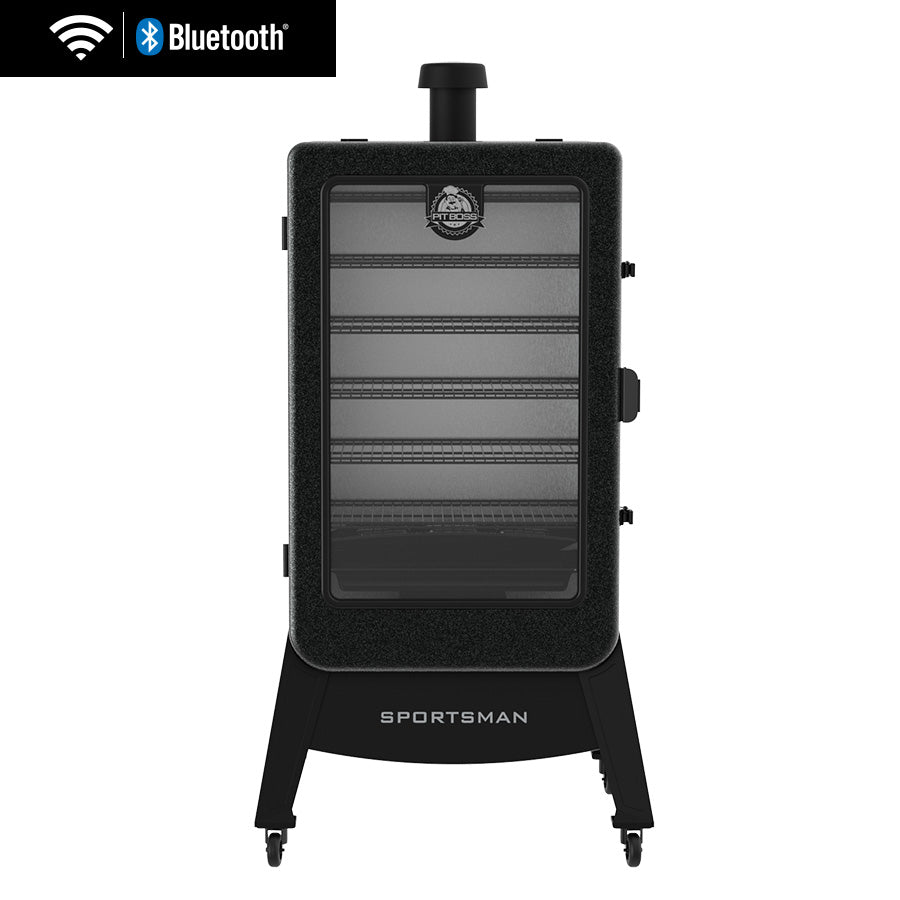
The largest vertical pellet cabinet Pit Boss sells direct: six adjustable racks totalling 2,015 sq in over a 60 lb hopper, in the Sportsman trim that replaced the Copperhead 5-Series. The cooking mechanism is identical to the Navigator 3-Series — auger-fed burn pot at the base, convection chimney above — but the extra rack and 900 more square inches move it into the range where it competes with a whole-hog cooker on volume alone.
Pit Boss
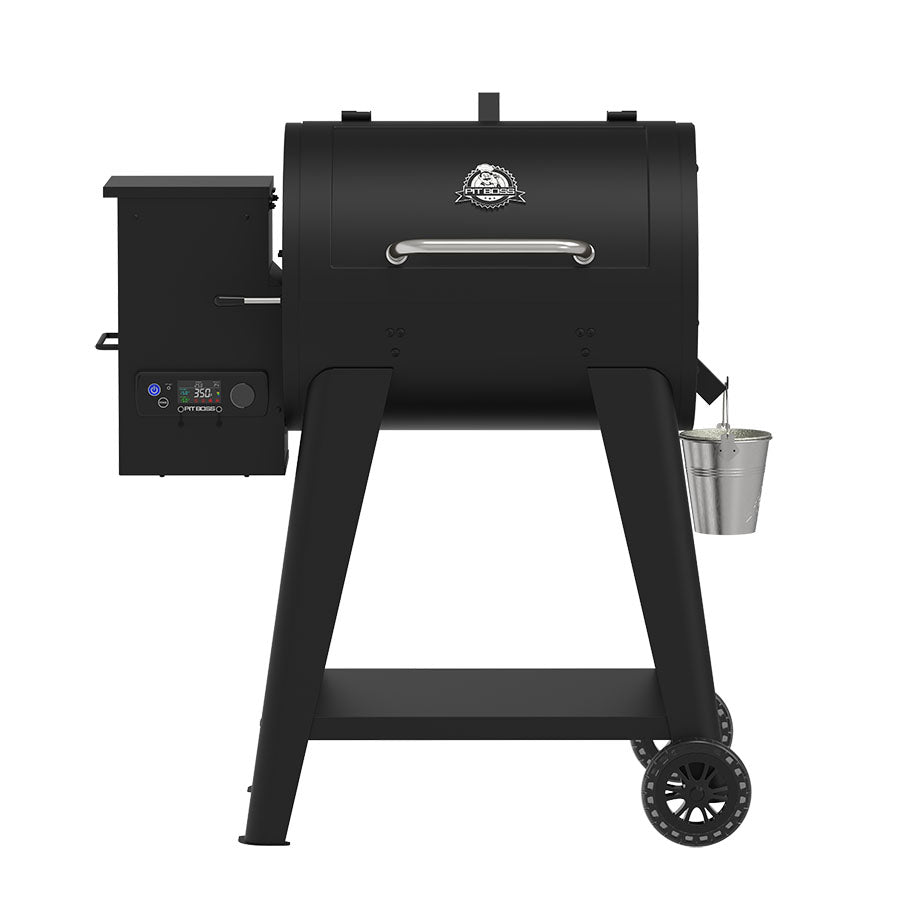
Pit Boss FB2 700
The FB2 line is the no-WiFi tier Pit Boss built when it retired the Pro Series, and the 700 is its middle size. The chamber runs 180–500°F on a digital board with 5°F steps, but the feature that defines every Pit Boss is the Flame Broiler lever — slide it and the heat deflector opens, exposing the firepot for direct-flame searing the company rates to 1,000°F. Two porcelain racks, 21 lb hopper, one probe included and a second port.
Pit Boss
Pit Boss Navigator 1300
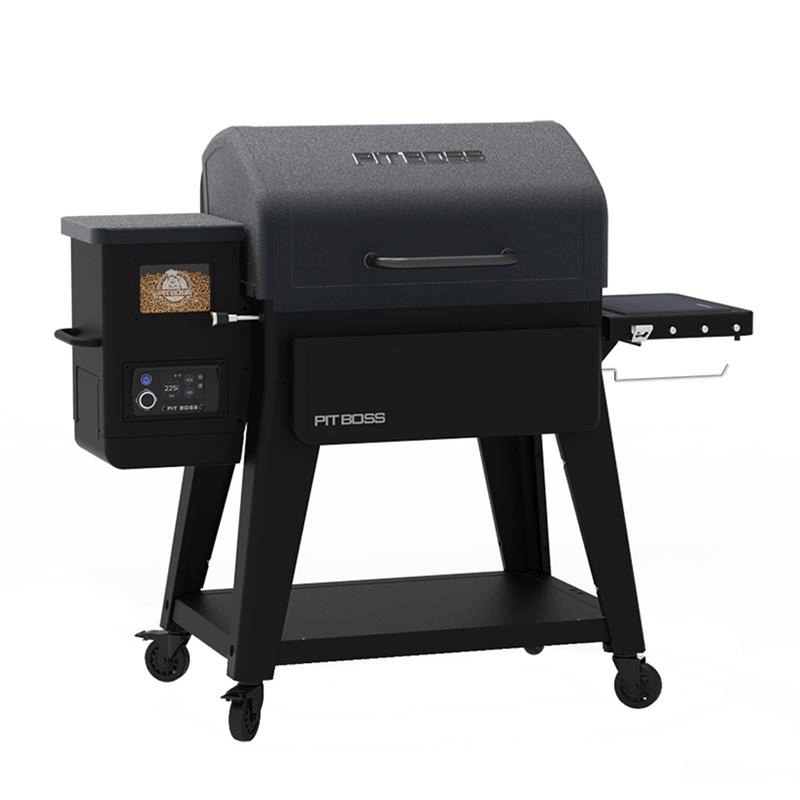
Navigator is the premium end of the current Pit Boss line — tapered legs, a fold-down prep shelf, a gravity hopper cleanout and a removable undermount burn pot for ash removal. The 1300 carries 1,329 sq in on a 30 lb hopper with two probes included. Everything mechanical below it in the line is the same: 180–500°F, 5°F increments, Flame Broiler lever for direct-flame searing.
Pit Boss
Pit Boss Navigator 1600
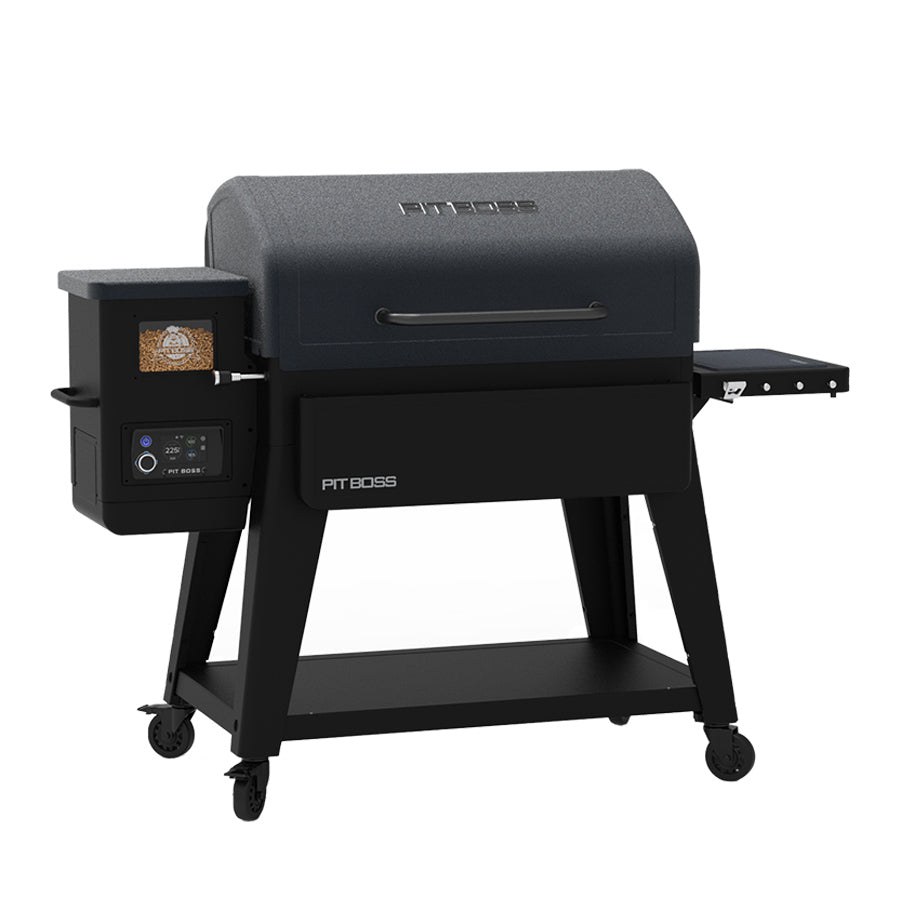
The largest grill Pit Boss currently sells and the direct replacement for the Pro Series 1600. It is the Navigator 1300 stretched to 1,593 sq in on the same 30 lb hopper, same controller, same 180–500°F range and same Flame Broiler lever. The hopper not growing with the chamber is the one spec worth noticing — more grate on the same fuel supply means shorter unattended runs when the grill is full.