
Masterbuilt
Masterbuilt Gravity Series 800
The Masterbuilt Gravity Series 800 is a digital, app-controlled charcoal grill, griddle, and smoker that uses a gravity-fed charcoal hopper and a fan-driven digital controller to automate charcoal cooking. It blends real charcoal flavor with set-and-forget convenience.
We may earn a commission. Price and availability on Amazon may differ.
Specifications
Features
Pros
- ✓It gives you real charcoal flavor with set-and-forget digital convenience - the fan-driven controller holds temp automatically like a pellet grill but burns lump or briquettes
- ✓It's wildly versatile, going from a 225°F low-and-slow smoke to a 700°F sear, and the included griddle insert turns it into a flat-top
- ✓The gravity-fed hopper holds up to ~16 lbs of briquettes for roughly 8+ hours of unattended cooking
- ✓The digital controller and Masterbuilt app let you set and monitor temps and probe alerts from your phone
- ✓It reaches genuine searing temps that pellet grills can't, so steaks and burgers get a real crust
- ✓800 sq in of cooking space plus the griddle option make it a true do-it-all charcoal cooker
- ✓At ~$650 it's a lot of capability and charcoal flavor for the money versus separate grill and smoker
- ✓It heats up fast - charcoal lights and reaches temp quicker than a traditional charcoal smoker
Cons
- ✗Reliability is the big knock - the control board, fan, and temperature sensors are known to fail, sometimes within the first year
- ✗The thin sheet-metal body and gaskets leak and wear, so many owners reseal it to hold temps and protect the electronics
- ✗The 1-year warranty is short for a $650 cooker with so many failure-prone electronic parts
- ✗It still needs power for the fan and controller, so it's not a true off-grid charcoal cooker
- ✗Ash and charcoal management is messier than a pellet grill, and the hopper/firebox area needs regular cleaning to run right
- ✗Smoke flavor, while real charcoal, can be lighter than a traditional offset unless you add wood chunks to the hopper or ash bin
- ✗The app and WiFi can be glitchy, dropping the connection mid-cook like many smart grills
- ✗Rain and moisture can wreak havoc on the electronics and charcoal, so it really needs a cover and dry storage
Owner Insightssummarized from owner discussions
The Gravity 800 is a gravity-fed charcoal smoker with a fan and a controller doing the fire management, and the idea works. Owners who came from pellet grills are consistent that it produces smoke flavor a pellet grill cannot, while still letting them sleep through an overnight brisket. It holds a hopper load through an eight-hour cook, takes a 10 lb butt and a 10 lb brisket at once, and then flips to direct heat for steaks in the same evening. An owner who also runs an offset called his brisket off this thing indistinguishable from his offset cooks.
The problem is durability, and it is not a minor asterisk. The failure list owners report is specific and repeated: controllers and fans that stop responding, door and lid switches, rust appearing within weeks, and grease fires serious enough to kill the fan mid-cook. One owner replaced the controller, both switches and the probe over a year, never fixed it, and was turned down when he asked for a replacement. The stock firebox steel burns through, so experienced owners treat aftermarket firebox, grate and manifold parts as a planned purchase rather than an upgrade. There is a measured hot spot near the firebox too, with one owner reading 325F on the right side against a 250F setting, which is usually the real explanation when ribs come out burnt on top.
It makes sense as a value buy, not a full-price buy. The people happiest with it paid $275 or $400 or $530 on a clearance shelf, added the firebox mod and a manifold cover, keep it covered and clean, and treat three or four years as a fair life. The people who paid full price and expected a decade mostly moved on, usually to a Kamado Joe or a Big Green Egg for durability, or to a Weber Searwood or Recteq for grilling flexibility. One more thing worth knowing before buying: charcoal by itself barely smokes in a gravity feeder. Plan on wood chunks in the hopper and the ash catcher, or a pellet tube, or you will get an expensive outdoor oven.
What owners like
- +It delivers charcoal smoke that pellet grills do not. Owners who came from a Traeger Ironwood 650 or 780 Pro describe the difference in flavor, color and bark as not close, and one owner running an offset, a WSM, a Traeger and a Recteq alongside it calls the Masterbuilt his go-to for exactly that reason.
- +Fuel autonomy on a long cook is genuinely good. Owners report running an 8-and-a-half-hour brisket on a single hopper load, only topping up because they started conservatively.
- +Capacity is real. Owners routinely run a 10 lb pork butt and a 10 lb brisket at the same time, and one planned a 16 lb packer plus a 12 lb butt plus two racks of spares in one session.
- +It does both jobs in one evening. One owner smoked lobster tails for an hour, then switched to direct heat and grilled New York strips, asparagus and corn in another 20 to 25 minutes.
- +Overshoot is recoverable in a way it is not on a kamado. Because the fan and damper are doing the work, owners who run hot can simply open the lid and bleed heat off.
- +Results stand up against a stick burner. An owner who also runs an offset described a Gravity 800 brisket as indistinguishable from his offset cooks, with the right jiggle.
- +It gets discounted hard and often. Owners report $700 and $530 sale prices, a $900 unit marked down to $275, and a weathered floor model talked down to $175, which changes the value calculation completely.
Common complaints
- −The electronics are the reason people leave. One owner spent a year replacing the controller, the door and lid switches and the temperature probe, still could not get the fan to kick on reliably, and was refused a replacement by the company. Another keeps a box of spare fans in the garage as a matter of course.
- −Support has a bad reputation among people who researched this grill. The recurring account is that parts fail often and customer care is unresponsive unless you escalate publicly on social media.
- −Rust shows up fast. One owner reports it starting within a few weeks of purchase, and another describes a unit covered in rust after only a few years.
- −Grease fires are a known hazard, not an edge case. One owner lost a pork butt when a grease fire killed the fan mid-smoke. Experienced owners buy an aftermarket manifold cover specifically to prevent this.
- −The stock firebox steel burns through. The standard advice given to new owners is to budget for thicker aftermarket firebox and grate parts before the originals fail, which means the real price is higher than the sticker.
- −It has a pronounced hot spot near the firebox. One owner measured the right side at 325F with the controller set to 250F, and that gap explains the burnt, overcooked ribs that turn up in owner troubleshooting posts.
- −Charcoal consumption is heavy. An owner who moved from a Big Green Egg to this and then to a Kamado Joe reports the Masterbuilt used roughly four times the charcoal for the same work.
- −Charcoal alone does not put much smoke on food. Owners who want real smoke layer wood chunks into the hopper and the ash catcher, or run a pellet tube alongside, and describe the tube as the way to get close to offset-quality smoke.
Common Questions
How reliable is it really?
Which mods should I buy before I need them?
Why does my food taste like it came out of an oven?
Why did my ribs burn when I set it to 250F?
How does it compare to a pellet grill for smoke flavor?
Is it worth full price?
Compare the Masterbuilt Gravity Series 800
Related grills
More from Masterbuilt →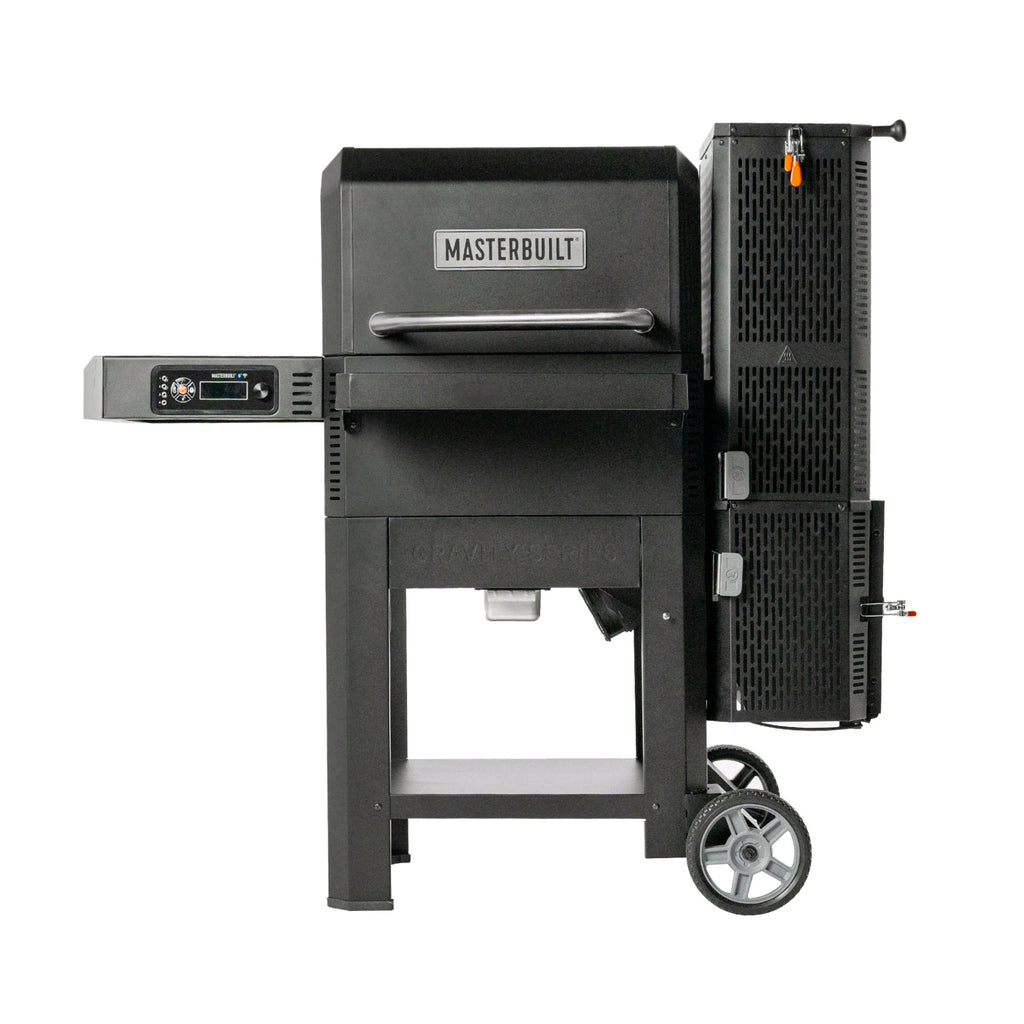
Masterbuilt
Masterbuilt Gravity Series 600
The current entry point to Masterbuilt's gravity-fed line and the direct replacement for the discontinued Gravity Series 560. A vertical hopper holds charcoal above the firebox and feeds it down by gravity while a variable-speed DigitalFan regulates air, so it behaves like a pellet grill but burns lump or briquettes. The 600 keeps the 560's footprint but adds dual-wall insulation with a porcelain interior and takes the hopper to 17.6 lb.
Masterbuilt
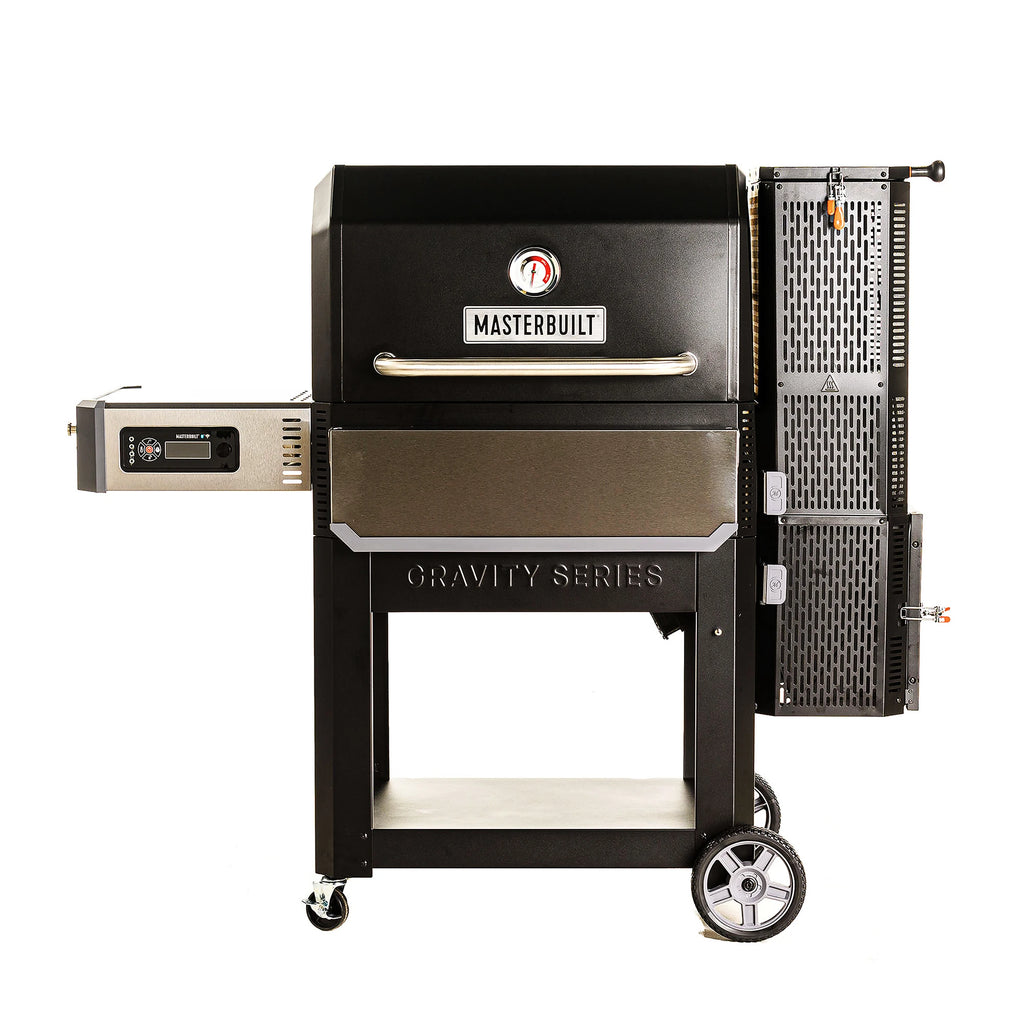
Masterbuilt Gravity Series 1050
The long-running large Gravity Series and still the volume seller of the line. Same gravity hopper and DigitalFan as the 600, in a wider cart-style body with 1,050 sq in across a main grate, a warming rack and a smoke rack. It sits between the 800 griddle-hybrid and the newer 1150 in Masterbuilt's range, and differs from the 1150 mainly in hopper size and cabinet updates rather than in how it cooks.
Masterbuilt
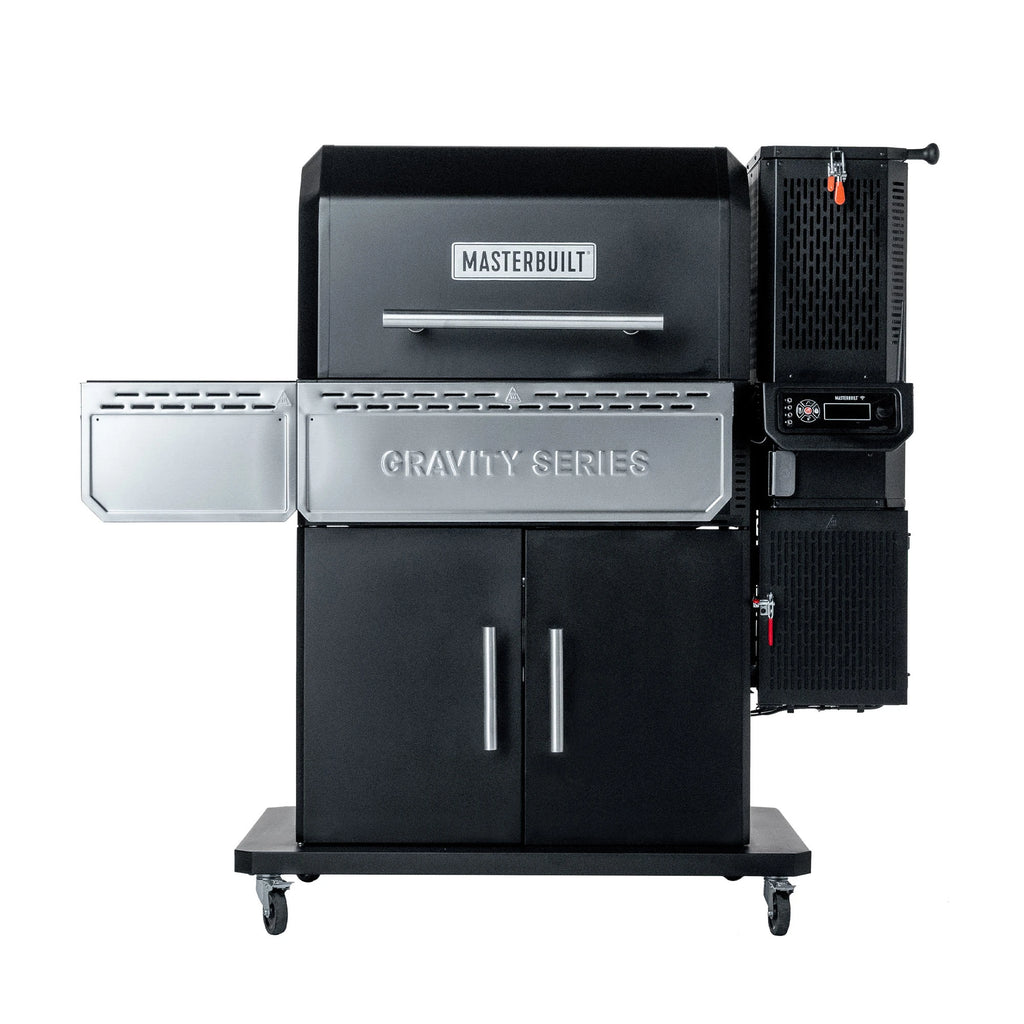
Masterbuilt Gravity Series 1150
The 2025 revision of the large Gravity Series, sold alongside the 1050 rather than replacing it. It adds 100 sq in, takes the hopper from 15.9 to 17.6 lb, and moves to a narrower and taller cabinet — 54.3 inches wide against the 1050's 60.6 — which is the real argument for it on a crowded patio. Masterbuilt rates the larger hopper at up to 15 hours of fuel.

Masterbuilt
Masterbuilt Gravity Series XT
The Gravity XT is Masterbuilt's current gravity-fed flagship and a direct response to the #1 complaint about the original 560/800/1050 series: build quality. The XT gets dual-wall FuelSaver insulation, a porcelain-coated interior, beefier hardware, and a 3-year warranty (up from 1), while keeping the party trick that made the line famous - real charcoal flavor with pellet-grill automation, from a 225F smoke to a legitimate 700F cast-iron sear in minutes. Owners and reviewers consistently call it the best-cooking gravity smoker you can buy, with better fuel efficiency and steadier temps than the old 1050 and the Char-Griller Gravity 980. The honest caveats: at $1,799 it costs nearly triple what a Gravity 800 street-prices for, it's a 199 lb two-person assembly job, and the electronics-in-a-charcoal-grill concern hasn't vanished - fans, switches, and control boards remain the failure points owners report, though XT-generation complaints are notably rarer. The hopper's 12 lbs of lump or 18 lbs of briquettes genuinely runs an overnight brisket. If you want charcoal taste with an app and don't want a Big Green Egg's learning curve, this is the class leader.
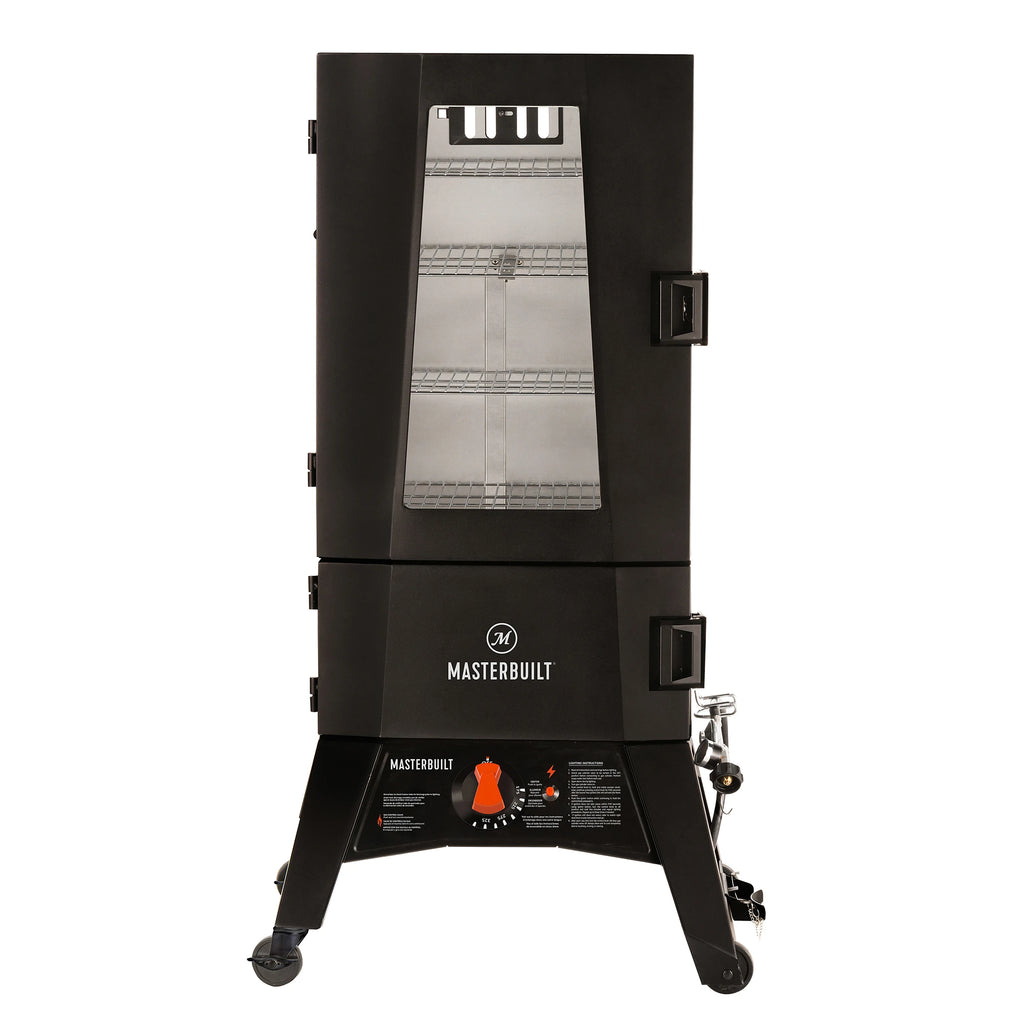
A propane vertical cabinet, which sits between an electric smoker and a charcoal one: a single burner at the base heats a wood-chip tray, and the ThermoTemp thermostat opens and closes the gas valve to hold a set temperature the way a gas oven does. That thermostat is the distinguishing feature — most propane cabinets in this price band have a manual needle valve and drift with the weather. 960 sq in over four racks, and a 375°F ceiling that beats every electric cabinet here.
Masterbuilt
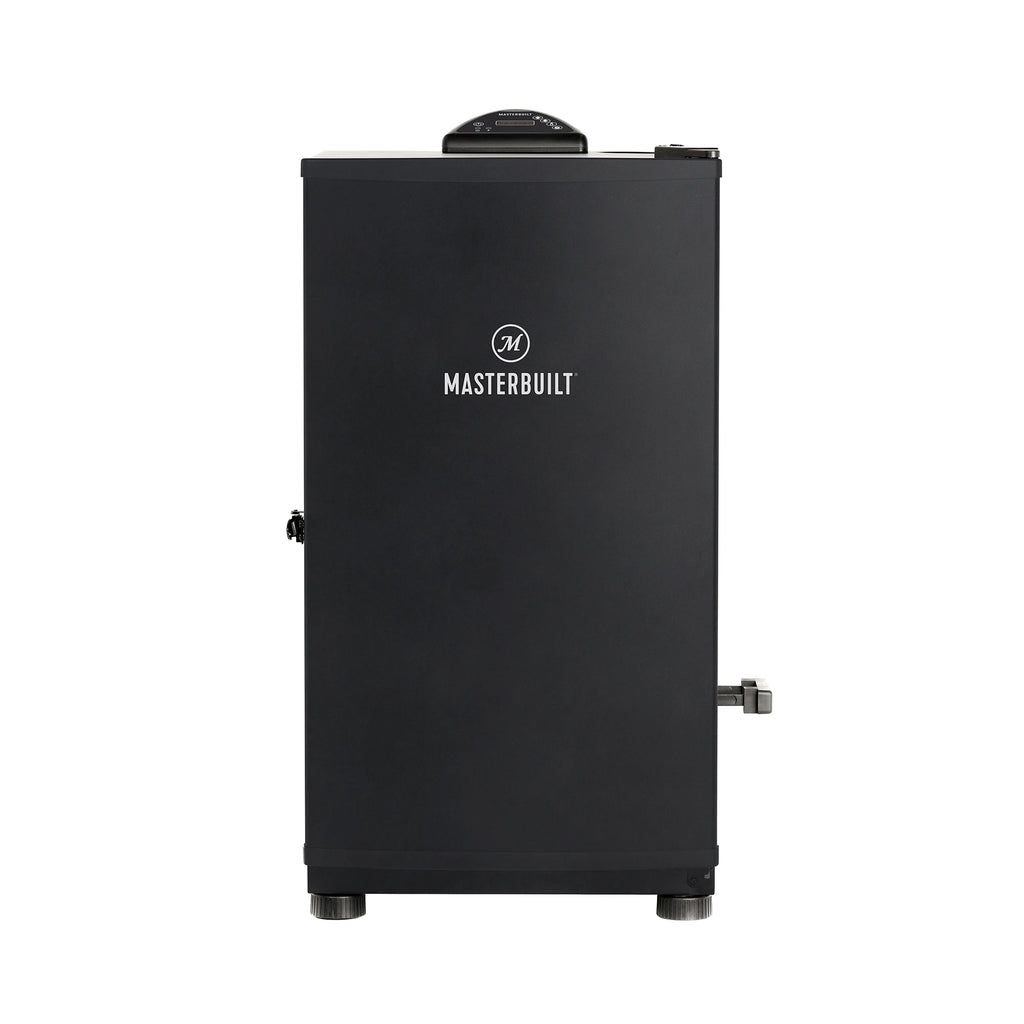
Masterbuilt 40-Inch Digital Electric Smoker
The 40-inch step up from the 30-inch already in the catalog: the same insulated cabinet and side wood-chip loader, stretched to four racks and 970 sq in. An electric smoker heats with a resistance element and makes smoke by smouldering chips in a tray beside it, which is a fundamentally different mechanism from a pellet cabinet's auger — the smoke is thinner and more controllable, and you can hold 160°F for cold-ish work such as sausage or cheese. The viewing window and glass door are on the pricier Window and Legs variant, not this one.