
Char-Griller
Char-Griller Akorn Kamado
The Char-Griller Akorn is a budget kamado-style grill that uses triple-wall insulated steel instead of ceramic to deliver kamado-like efficiency at a fraction of the price. It's the popular gateway into kamado cooking.
We may earn a commission. Price and availability on Amazon may differ.
Specifications
Features
Pros
- ✓At ~$350 it delivers most of the kamado experience for a quarter of a ceramic Egg's price - the best budget on-ramp to kamado cooking
- ✓Triple-wall insulated steel gives surprisingly good heat retention and fuel efficiency, close to ceramic for the money
- ✓Because it's steel, it's far lighter (97 lbs) than ceramic kamados and won't crack if it tips over
- ✓314 sq in of cast-iron grate plus a warming rack gives more usable space than a Large Egg costing three times as much
- ✓It holds low-and-slow temps well once dialed and easily reaches high searing heat too
- ✓The easy-dump ash pan makes cleanup much simpler than scooping ash out of a ceramic kamado
- ✓The locking lid and built-in thermometer add convenience at the budget price
- ✓A huge owner community shares mods (gasket upgrades, etc.) that make it perform even closer to ceramic
Cons
- ✗Steel doesn't retain heat as well as ceramic, so it's more sensitive to wind and ambient temperature swings
- ✗The thin steel can rust over time, especially at the bottom and around the firebox, shortening its lifespan versus ceramic
- ✗The stock felt gasket wears out and many owners replace it to fix air leaks and temp control
- ✗It can't hold temps for marathon overnight cooks quite as effortlessly as a thick ceramic kamado
- ✗Build quality and longevity are clearly budget - expect maybe 3-6 years versus a ceramic kamado's lifetime
- ✗The warranty is limited and shorter than the lifetime ceramic coverage of premium kamados
- ✗Paint can chip and the metal can warp with repeated high-heat cooks
- ✗The accessory ecosystem is far smaller than Big Green Egg or Kamado Joe
Owner Insightssummarized from owner discussions
The Akorn is a kamado made of insulated steel rather than ceramic, and the owner verdict on it is unusually consistent: it delivers most of what a ceramic kamado delivers for roughly a quarter of the price, and it will not last as long. Owners describe it as the cheapest way to find out whether you like the kamado format, and a striking number of the people who say that are writing from the other side of the decision, having since moved to a Big Green Egg or a Kamado Joe and still calling the Akorn the better bargain. The fuel efficiency is what converts people. Running a full brisket without refuelling is routine, and one owner reports 30 hours at 225F from a single basket, numbers an offset owner finds hard to believe.
The experience out of the box is worse than the experience after an hour of work. Air leaks around the ash pan, the lid seal and the bottom vent slide are common enough that failing temperature control is the single most-discussed problem with this grill, and the fix is always the same: gasket those three places and it becomes stable. Owners who skip that step report the fire dying at 250F and then overshooting the moment they open a vent a few millimetres. Once sealed it holds a line well, including in cold and wind, where kettle owners are losing the fight. Start-up is slower than a kettle at 20 to 25 minutes to searing heat, and the efficiency cuts both ways, since a low-oxygen fire produces less smoke than some owners want.
It suits someone who wants kamado cooking without kamado money, or who moves house and cannot trust a mover with 200 lbs of ceramic. The comparison owners make most often is to the Weber Summit Kamado, which costs roughly $900 more and gives a 24 inch grate against the Akorn's 20, and the honest answer is that the Summit's advantage is the cooking surface as much as the build. Against a Weber kettle the Akorn wins on fuel, cold-weather stability and long cooks, and loses on speed, two-zone work and the size of the accessory market. The caveat everyone should price in is rust: owners budget around five years, keep it covered, and treat the low purchase price as buying time to decide whether ceramic is worth it.
What owners like
- +Fuel efficiency is the headline and it is not exaggerated. Owners run a full brisket with no refuelling, and one who kept his for years reports 30 hours at 225F on a single basket. People coming from offsets describe burning a bag of charcoal plus three quarters of a bag of chunks on an eight-hour cook and then saving a small fortune once they switched.
- +The value argument is blunt and owners make it repeatedly: it cooks like a ceramic kamado for around $300. One long-time owner says he would rather have four of them than one Big Green Egg, and another calls it the best bargain in barbecue.
- +It holds temperature well in cold and wind, which is why kettle owners fighting their vents in winter look at it. The insulated steel body is far less affected by ambient conditions than a single-wall kettle.
- +It handles the full range. Owners cook 14 lb briskets over ten hours, pastrami, pork shoulders, pizza at 650F, and hard sears by opening the ash pan hinges wide and raising the charcoal grate closer to the food.
- +There is more space between the coals and the grate than on a kettle, so direct grilling bone-in chicken and other fatty cuts is less of a burning game than it is on a Weber.
- +At around 100 lbs of steel and fibreglass it moves. Owners pick it specifically because movers can handle it, it fits in the back of a small SUV with the seats folded, and it will not crack if it tips over, which is the reason renters choose it over ceramic.
- +The used market is extraordinary. Tidy ones show up around $150 to $200 with a heat deflector included, and one owner rebuilt a $40 find with a pressure wash, cleaning vinegar, a wire brush and a can of grill paint.
Common complaints
- −Out of the box it leaks air, and that is the single biggest complaint. Owners describe temperatures that die at 250F and then run away the moment they crack a vent further. The fix is consistent and well documented: gasket the ash pan, the main lid seal and the bottom vent slide, after which owners report it goes rock stable.
- −Rust is the life-limiter. Owners plan on roughly five years before rust-out, grates corrode quickly if it sits unused, and units left uncovered come back with the inside completely rusted through. The damper hardware is another weak point, with at least one owner having the top damper crack away from the lid entirely.
- −It is so efficient and so starved of oxygen on low cooks that some owners find the smoke flavour thinner than they expected, and end up reaching for a kettle instead. Others report the opposite against a leaky offset, so it depends on what you are comparing against.
- −Real two-zone cooking is awkward. One owner who loved his and used it for every long smoke says he bought a Weber kettle specifically because he could never get proper two-zone going on the Akorn, workarounds notwithstanding.
- −Start-up is slower than a kettle. Owners budget 20 to 25 minutes to reach searing temperature, which is enough that people with both grab the kettle for weeknight burgers.
- −The aftermarket is thin. Owners who want a heat deflector, a fan controller or a better charcoal basket are mostly adapting parts made for 18 to 20 inch ceramic kamados, and one long-term owner names the missing accessory ecosystem as the thing holding the platform back.
- −Practical annoyances add up: the folding side shelves make it difficult to fit a cover, which matters a lot given the rust problem, and on the controller-equipped version owners report the controller failing and leaving them back on manual vents.
Common Questions
Why can't I hold a steady temperature?
How long will it run on one load of charcoal?
How long will one last?
Akorn or a ceramic kamado?
Is the version with the built-in controller worth it?
Can it do pizza?
Compare the Char-Griller Akorn Kamado
Related grills
More from Char-Griller →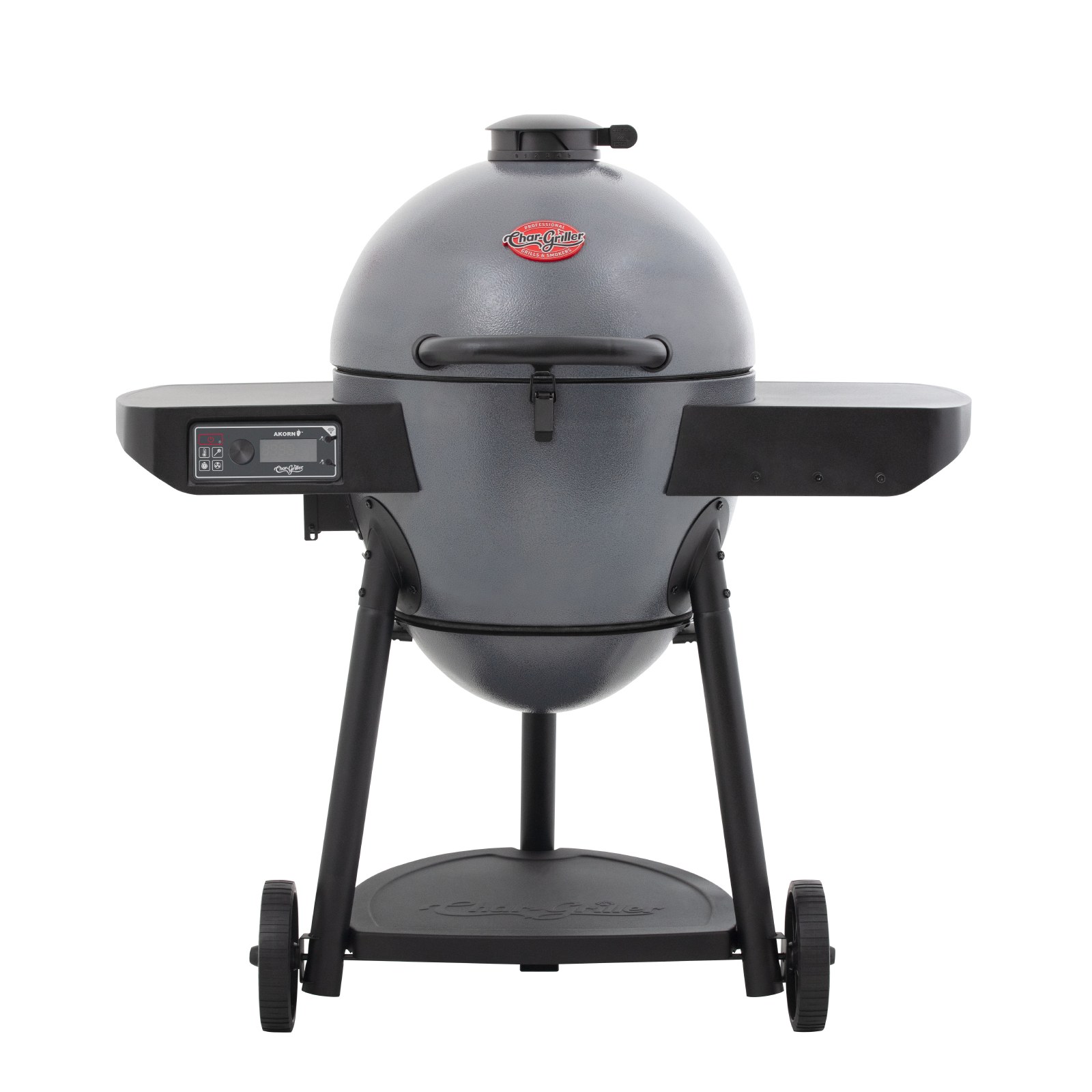
Char-Griller
Char-Griller AKORN Auto-Kamado
The Akorn Auto-Kamado is the steel Akorn body with a digital controller and a fan that manages airflow automatically, plus Wi-Fi so the temperature can be set from a phone. It is the cheapest way to get set-and-forget charcoal control — the feature that otherwise means a $2,000 Konnected Joe or a third-party fan controller. Everything below the controller is the standard Akorn: triple-walled insulated steel rather than ceramic, cast iron grates, and an EasyDump ash pan. Char-Griller no longer lists the Auto-Kamado itself — only its cover remains on the maker's store — and the $449.99 that once bought it now buys the plain AKORN Kamado with the cart. It is still widely owned and still turns up at retail, which is why it stays here.
Char-Griller
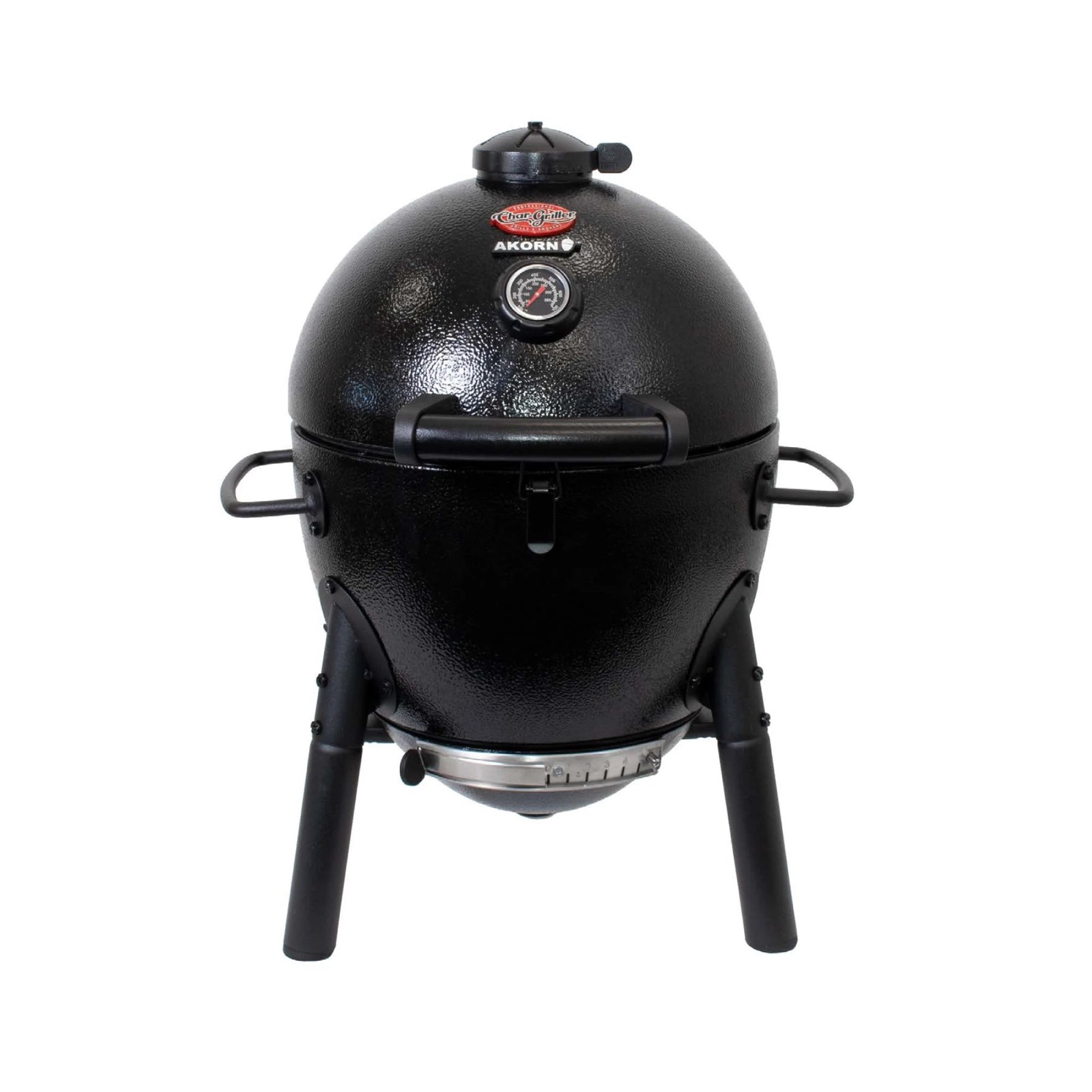
Char-Griller AKORN Jr.
A tabletop steel kamado: 155 sq in, 36 lbs, side carry handles, and the same triple-walled insulated body as the full-size Akorn. It is the cheapest kamado of any kind, and unlike the ceramic portables it can actually be carried by one person to a campsite or tailgate. Cast iron grates and a removable stainless warming rack come standard.
Char-Griller
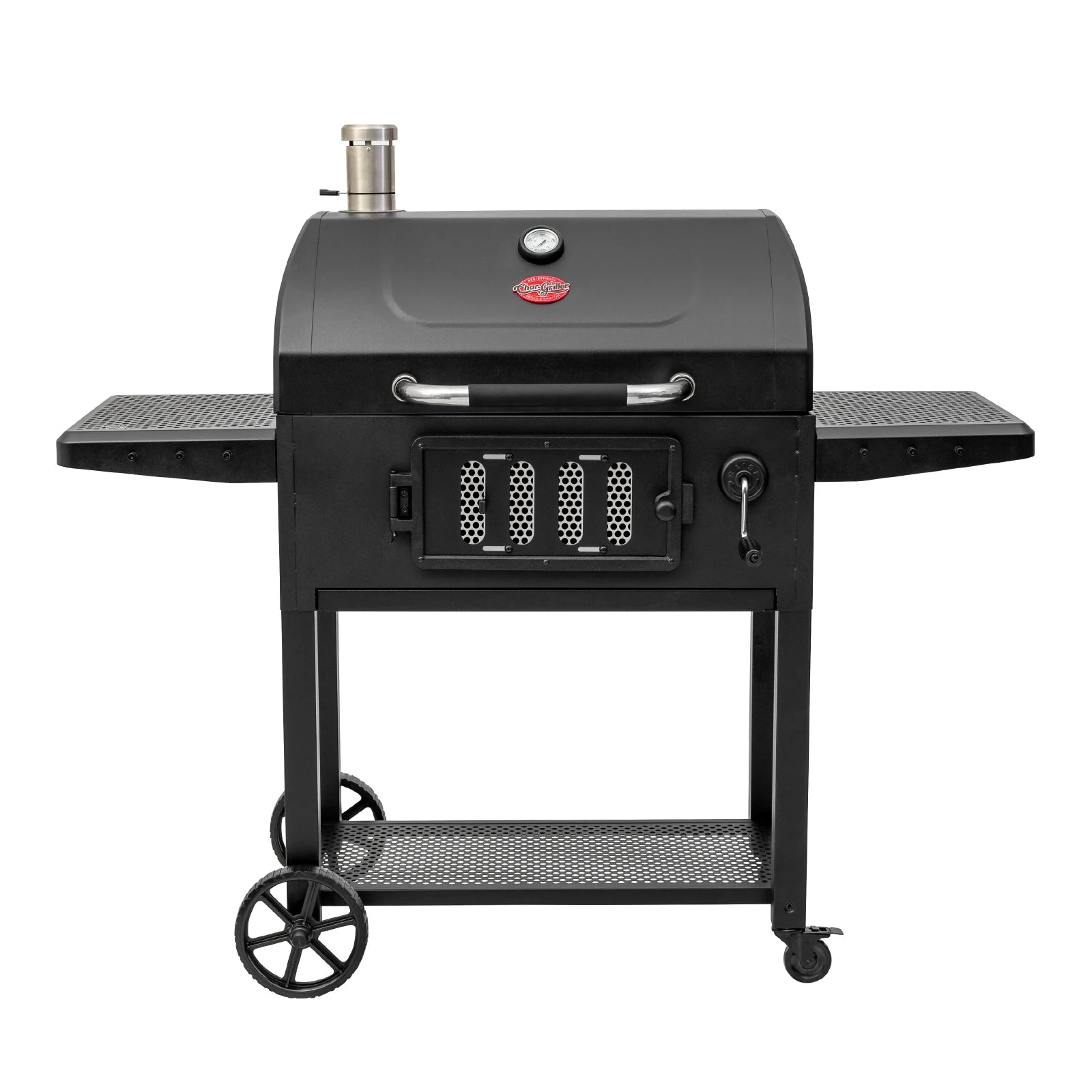
Char-Griller Classic Cart Style Charcoal Grill
This is the barrel grill Char-Griller has sold for decades under the Super Pro name; the 2026 catalog lists it as the Classic Cart Style Charcoal Grill, SKU 2175. It is a double-walled steel barrel on a cart with 550 sq in of primary grate plus a 260 sq in warming rack, an adjustable-height charcoal pan on a crank, and a side-firebox port so it can be converted into an offset smoker later. Compared with the Wrangler below it, it adds the crank-adjustable fire pan and the side-firebox port; compared with the Smokin' Champ above it, it ships without the firebox.
Char-Griller
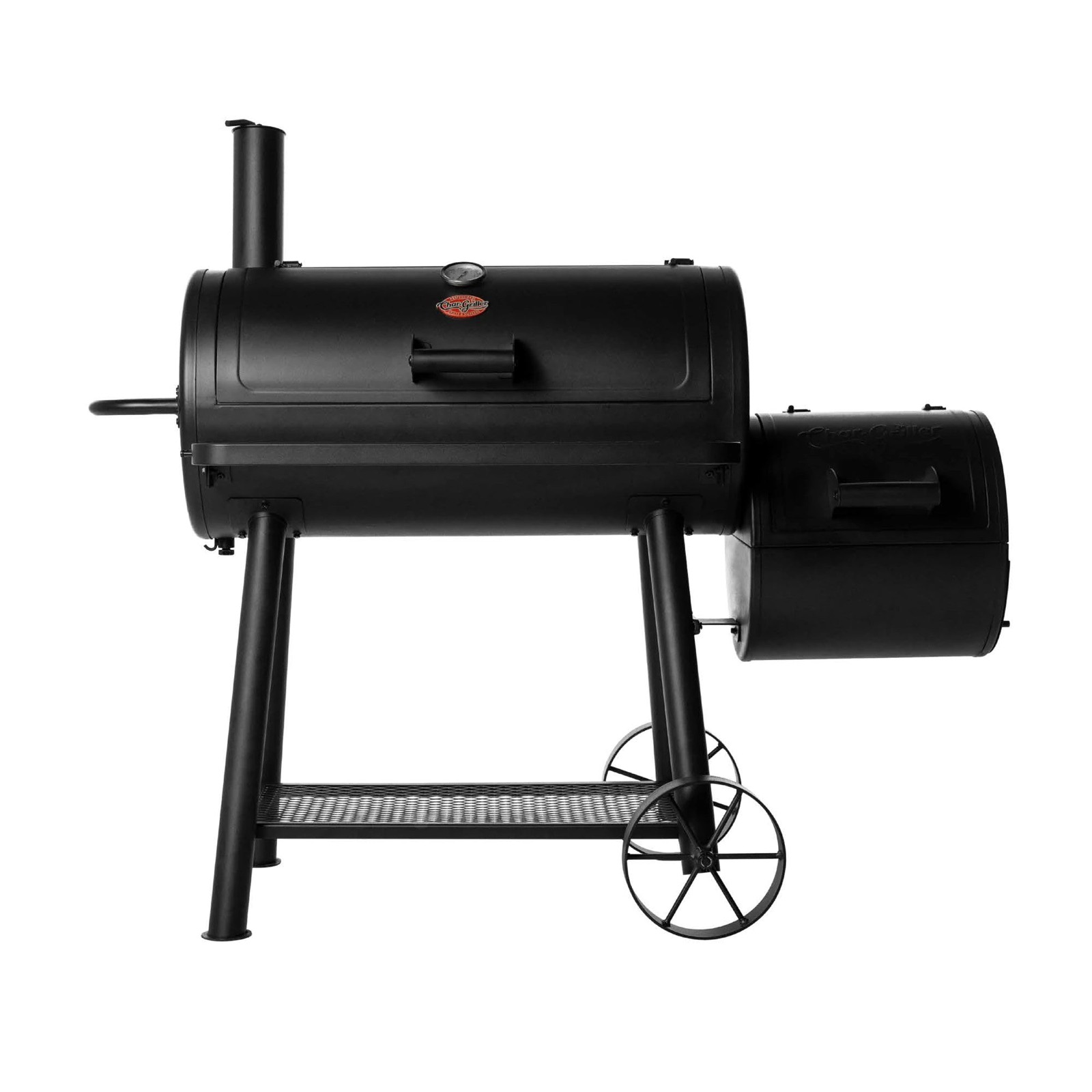
Char-Griller Dakota Offset Smoker
A newer Char-Griller offset that sits above the Competition Pro and below the Grand Champ: 580 sq in of cooking chamber, 141 lbs, and a firebox that takes splits rather than only charcoal. It is the model Char-Griller added when the entry-offset market moved upmarket, and at $400 it competes directly with the Oklahoma Joe's Highland Classic.
Char-Griller
Char-Griller Competition Pro Offset Smoker
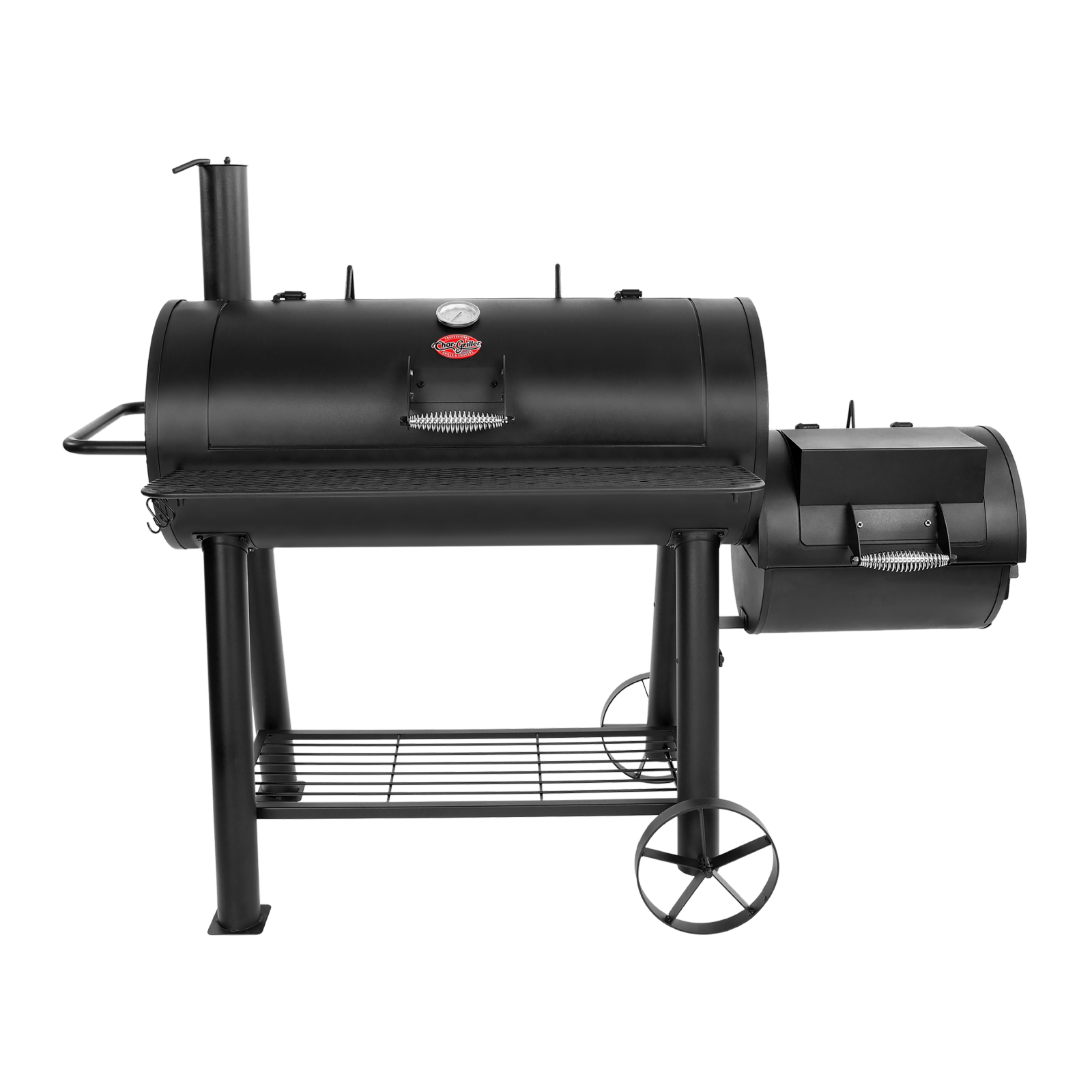
Char-Griller's Competition Pro is a Home Depot retailer exclusive that pairs a barrel grill with a bolted-on side firebox — the same architecture as the Smokin' Champ already in the catalog, but with 720 sq in of primary grate instead of the Champ's smaller chamber, and an insulated body. It is the cheapest true offset in Char-Griller's line that ships with the firebox included rather than as a $99 add-on.

Char-Griller
Char-Griller Smokin' Champ
The Char-Griller Smokin' Champ is a barrel-style charcoal grill paired with a side firebox for offset smoking, offering large capacity at a budget price. It's a flexible, affordable charcoal grill and smoker combo.