
Blackstone
Blackstone 36-Inch Griddle
The Blackstone 36-inch is the best-selling outdoor flat-top griddle in America, a 4-burner propane cooking station with a huge rolled-steel cooktop. It's the go-to for smash burgers, breakfast, hibachi, and big-batch cooking.
We may earn a commission. Price and availability on Amazon may differ.
Specifications
Features
Pros
- ✓The massive 768 sq in flat top cooks for a crowd - dozens of smash burgers, full breakfast spreads, fajitas, and hibachi all at once
- ✓Four independently controlled burners create distinct heat zones, so you can sear on one side and keep food warm on the other
- ✓Smash burgers come out with an unbeatable crispy crust that you simply can't get on a grill grate
- ✓The rear grease management system funnels drippings into a rear cup for fast, clean cleanup
- ✓At under $400 it's an incredible value for the cooking real estate and versatility you get
- ✓It heats edge-to-edge quickly and the rolled-steel top, once seasoned, becomes a naturally non-stick surface
- ✓Casters make the big unit easy to roll around, and the side shelves give ample prep and plating space
- ✓The enormous owner community shares endless recipes, seasoning tips, and accessory ideas
Cons
- ✗The bare steel cooktop requires seasoning and ongoing rust prevention - leave it uncovered in the rain and it'll rust
- ✗It's purely a griddle, so you can't grill with grate marks or do low-and-slow smoking on it
- ✗Maintaining the seasoning is a chore - you oil it after every cook and re-season periodically
- ✗The base model has no lid/hood, so wind affects heat and you can't easily melt cheese or steam without a basting dome
- ✗Build quality is value-grade and the 1-year warranty is short; burners and igniters can need replacing over time
- ✗It's a big 64.5-inch footprint that takes up significant patio space and storage
- ✗The igniter is a common weak point that owners often end up lighting manually with a torch
- ✗Without a cover, condensation and humidity alone can cause surface rust between cooks
Owner Insightssummarized from owner discussions
The 36 is the default big griddle, and the owner conversation around it is less about whether it is good than about what you should pay and which of the five near-identical versions you are looking at. Original, Omnivore, Iron Forged, Culinary and Pro Series all exist as 36-inch models, retailers stock exclusives, and the same griddle turns up at $549 direct, $599 at one chain and $697 at another in the same week. Meanwhile the deal reports run $285 at Target, $399 at Costco, $420 marked down at Walmart, and $179.99 on a flash sale. Buying this at full price is something owners actively warn each other out of.
What you get is enormous capacity and heat zoning that the smaller griddles cannot match, and owners use it that way: cooking for 20, six pounds of London broil in one go, full breakfasts with a warm zone in play. What you also get is the category's maintenance tax plus some specific defects. Warping is the most-discussed problem here and it tends to progress, going from occasional to every cook, with the top lifting on one side until oil runs downhill. The igniter is the second, failing within weeks for some owners even under cover, and the design has no manual lighting holes to fall back on. Rust arrives on new units often enough that it is a routine question, rodents get into a griddle left standing between weekends, and the casters wobble on anything but flat ground.
Buy it if you cook for crowds, you are patient enough to wait for a sale, and you accept an infrared thermometer, a cover and a silicone mat as part of the purchase rather than accessories. Buy the 28 instead if it is usually two of you, because the space you will not use still has to be seasoned, oiled and stored. The honest caveat is that the build matches the price, not the brand's reach: this is a griddle people buy twice in a decade and do not particularly mind, rather than one they expect to keep forever.
What owners like
- +Almost nobody pays the shelf price, and the deal reports are specific enough to plan around: $285 at Target against a $500 tag, $399 at a Costco where the same unit was $499 online and $599 on the brand site, $420 marked down at Walmart for a Pro Series, and $179.99 on a Woot run for an Omnivore. Owners who waited a season report saving $200 or more.
- +The used market is even better and it is busy. Reported buys include $240 on Facebook Marketplace with a cover, $400 for one with a lid and a full accessory kit, and $100 for a rusty one that came back with a weekend of seasoning. Surface rust is the main thing to inspect, and it is cosmetic.
- +The capacity is the reason people put up with everything else. Owners routinely take it on as the cooking for parties of 20, and one asked the long-term threads whether it could feed 50 with no griddle experience and got talked through it rather than told no. Six pounds of London broil at once is a normal Saturday.
- +Four burners across 36 inches gives a genuine hot end and a holding end, which is what owners cite when they talk anyone out of the 28. Running a sear zone while a second zone keeps a batch warm is the thing that stops a crowd cook from turning into relay racing.
- +Warranty support is better than the value-grade build suggests. One owner whose Costco unit had sides that were not square, so the lid scratched itself every time it closed, was sent an entire replacement griddle and lid rather than a part.
- +Once it is going, the food is the payoff, and the enthusiasm in the threads is not manufactured. First-cook posts from people who already own kamados and offsets describe the griddle as the thing that comes out two or three times a week while the smoker waits for the weekend.
Common complaints
- −Warping is the single biggest topic, and it gets worse rather than better. The most-discussed thread on this griddle is one owner whose top started lifting on the right at every cook after previously doing it only rarely, with food brought to room temperature first. It usually flattens as it cools, but by then oil has pooled to one side mid-cook.
- −The igniter is a known failure and the design gives you no fallback. One owner of a 36-inch Pro had it work for a week, die, get replaced with a whole new box from support, and die again after three or four more cooks, all on a covered porch under a heavy cover. Their specific complaint is that there are no holes for lighting a burner manually.
- −Rodents treat it as furniture. Owners report mouse droppings on the cooktop every week at a cottage left alone between visits, and one describes a neighbor whose wiring was chewed through completely under a soft cover. The standard fix is a silicone mat laid right on the steel, which people find for $15 to $17.
- −The model names are close to meaningless at the shelf. Original, Omnivore, Iron Forged, Culinary and Pro Series all sell as a 36, retailers carry exclusive versions of each, and shoppers regularly cannot tell what separates a Costco Omnivore from an Iron Forged. Comparing on price alone is how people end up paying $697 at one store for what is $549 direct.
- −Rust shows up before the first cook for some buyers. Several report edge rust and spots on the surface of a griddle straight out of the carton, and separately a sticky brown factory coating on the top, sides and underside that alarms first-time owners who have not been told to expect it.
- −Wobble on the casters is common and not easy to chase down. Owners report tightening every caster and screw, checking for loose hardware, and still getting side-to-side movement, with sloped paver patios making it worse.
- −Nothing on the hood tells you the temperature. Owners stepping across from a gas grill notice immediately that there is no lid gauge, and the answer in the threads is an infrared thermometer rather than an accessory, which is a real added cost on a griddle bought partly on price.
- −It is large enough to become a housing problem. One owner cooking on a townhouse patio two or three times a week was given four weeks to remove it under a blanket ban on grills and fire pits, and placement questions from people with fences, siding and covered porches near the cooktop are constant.
Common Questions
Should I get the 36 or the 28?
Is my griddle warping, and is it ruined?
What is the difference between the Omnivore, Iron Forged, Culinary and Pro Series?
What price should I wait for?
How do I stop mice getting on the cooktop?
Do I need to re-season after every cook?
Compare the Blackstone 36-Inch Griddle
The Blackstone 36-Inch Griddle is one of 4 sizes in this line.
See every size, to scale →Related grills
More from Blackstone →
Blackstone
Blackstone 28-Inch Griddle
The Blackstone 28-inch is the compact 2-burner version of America's favorite outdoor griddle, offering the same flat-top cooking in a smaller footprint suited to smaller patios and families. It's a top-selling entry griddle.

Blackstone
Blackstone 22-Inch Tabletop Griddle
The 22-inch tabletop is the best-selling portable griddle in America and the default answer whenever the question comes up about camping, tailgating, or balcony setups. Two independently controlled H-burners give you a real two-zone flat top - eggs and pancakes on low, smash burgers screaming hot on the other side - and 361 sq in is legitimately enough to feed six to eight people, which no portable grate grill this size can match. It screws onto a 1 lb propane canister and hits searing temps fast, though owners recommend the 20 lb tank adapter hose because it burns through the little green bottles quickly. Honest downsides: like every bare-steel Blackstone the cooktop rusts if stored damp, so seasoning and a cover are mandatory; the burners struggle in wind without a shield; the low-end simmer is touchy; and at 32 lbs it's luggable, not light. Quality control complaints (warped tops, sticky regulators) show up in reviews at a low but real rate, and the warranty is only a year. For the price of a nice dinner out, though, nothing else cooks this much food this portably.
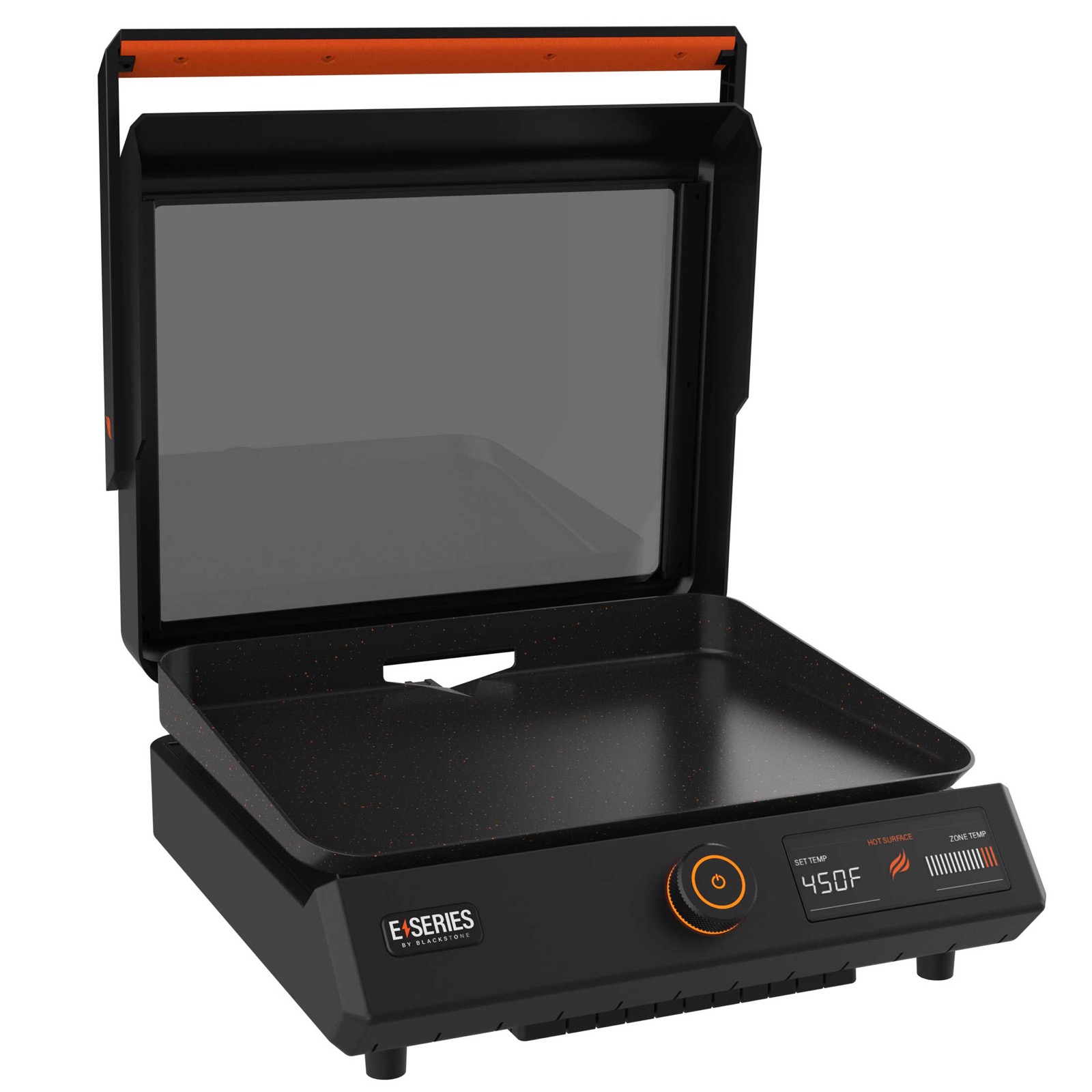
Blackstone's 1,500 W plug-in griddle, with an LCD dial-set temperature readout and a ceramic-titanium non-stick plate instead of the bare carbon steel the propane models use. It runs on a standard 120 V household outlet and has a rotate-and-remove glass hood. This is the only Blackstone that works where open flame is not an option.
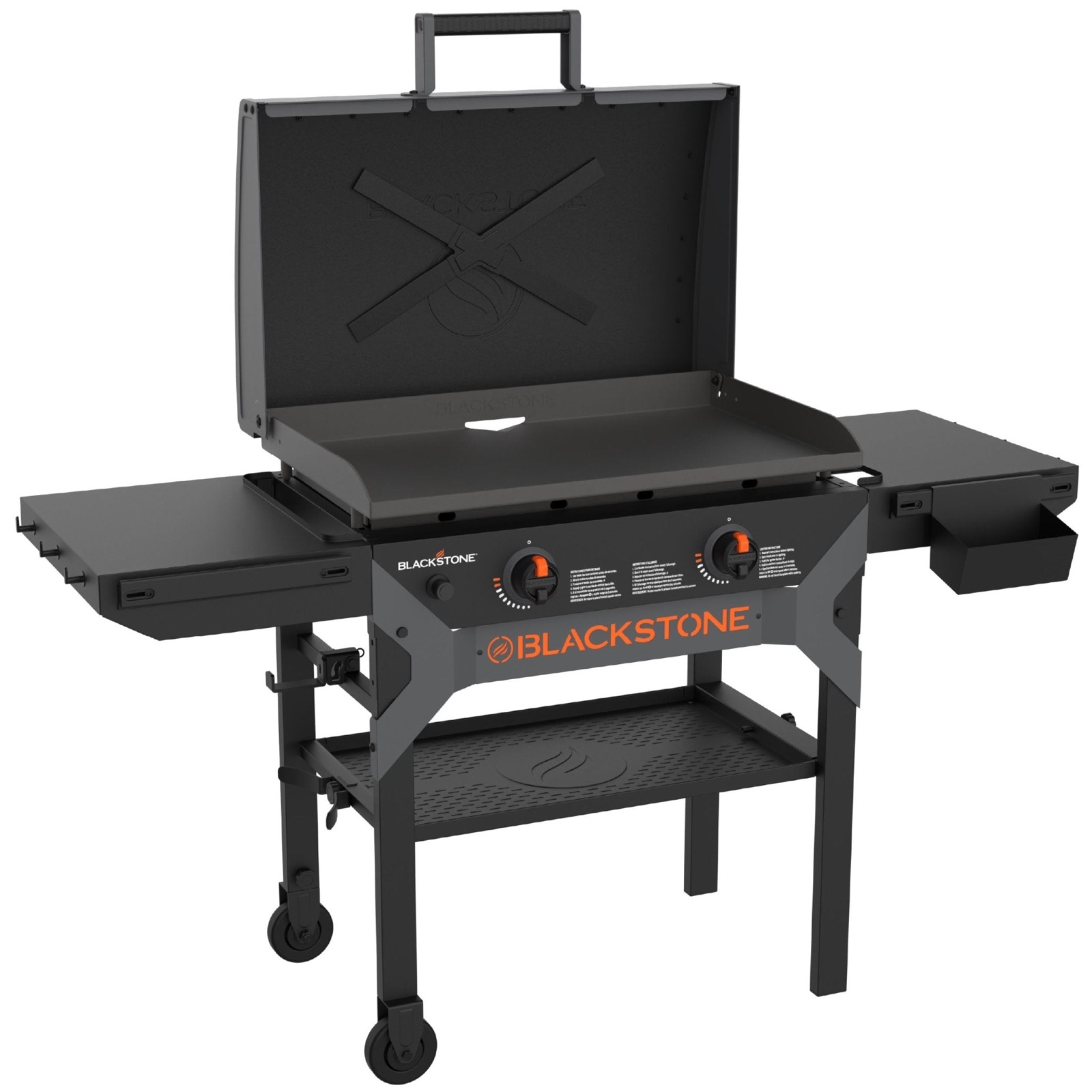
Iron Forged is Blackstone's 2025-26 rebuild of the classic 28-inch cart griddle, and this is the hooded two-burner version. The change that matters is the Omnivore griddle plate — a ridged-underside plate that spreads burner heat more evenly than the flat plate on the Original 28 the catalog already lists, which is the single most common complaint about older Blackstones. It also adds a side-shelf accessory rail and a hood the Original 28 at $227 does not have.
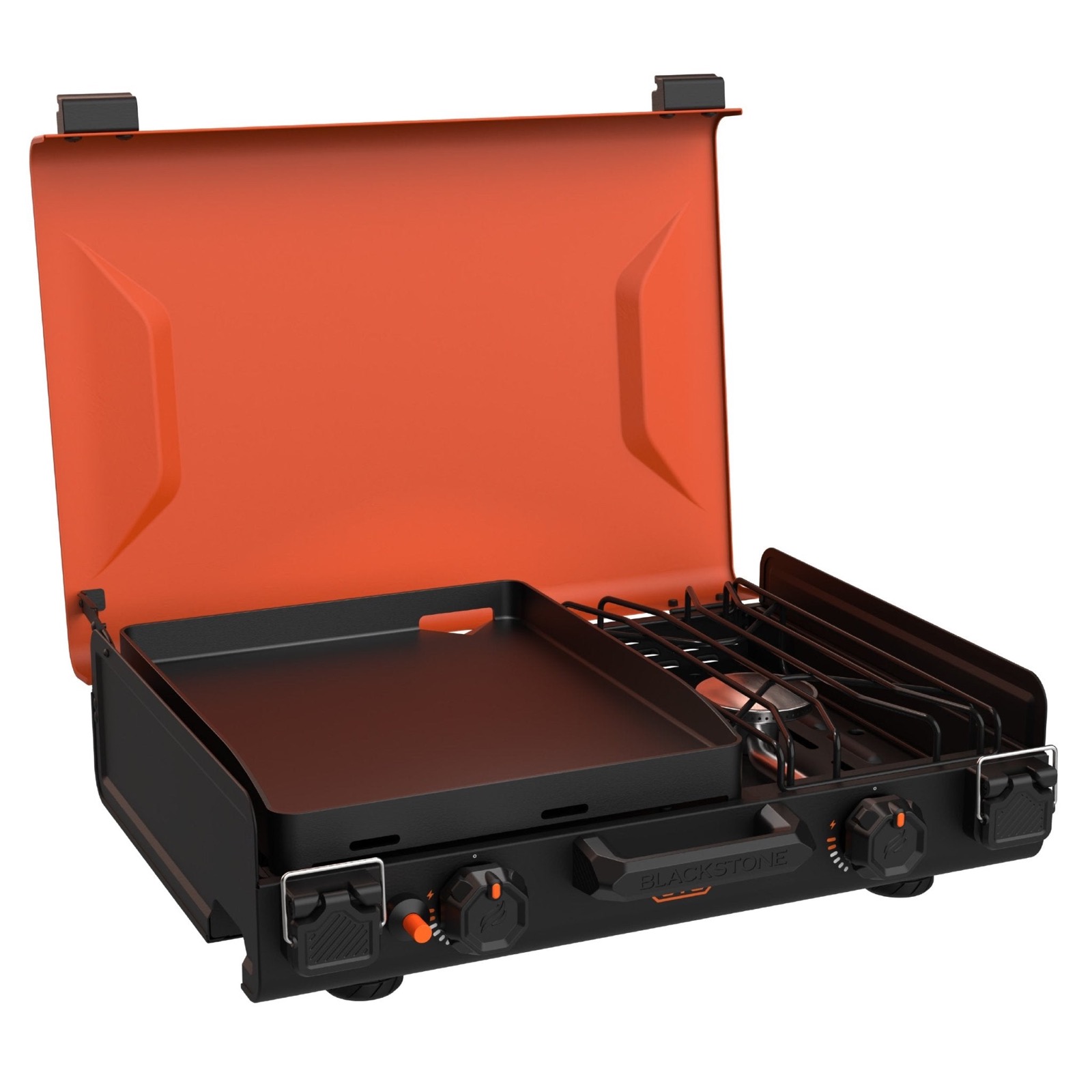
Blackstone's camping unit: a 12 x 14 inch griddle plate and a separate round side burner in one 25 lb case with a latching hood and a carry handle. Both run off 1 lb canisters or, with an adapter, a bulk tank, and Blackstone's propane chain system lets it daisy-chain fuel to a second unit. The side burner is what separates it from every other tabletop griddle — coffee, beans or sauce goes on the burner while the griddle stays clear.
Blackstone
Blackstone 28" Griddle with Air Fryer
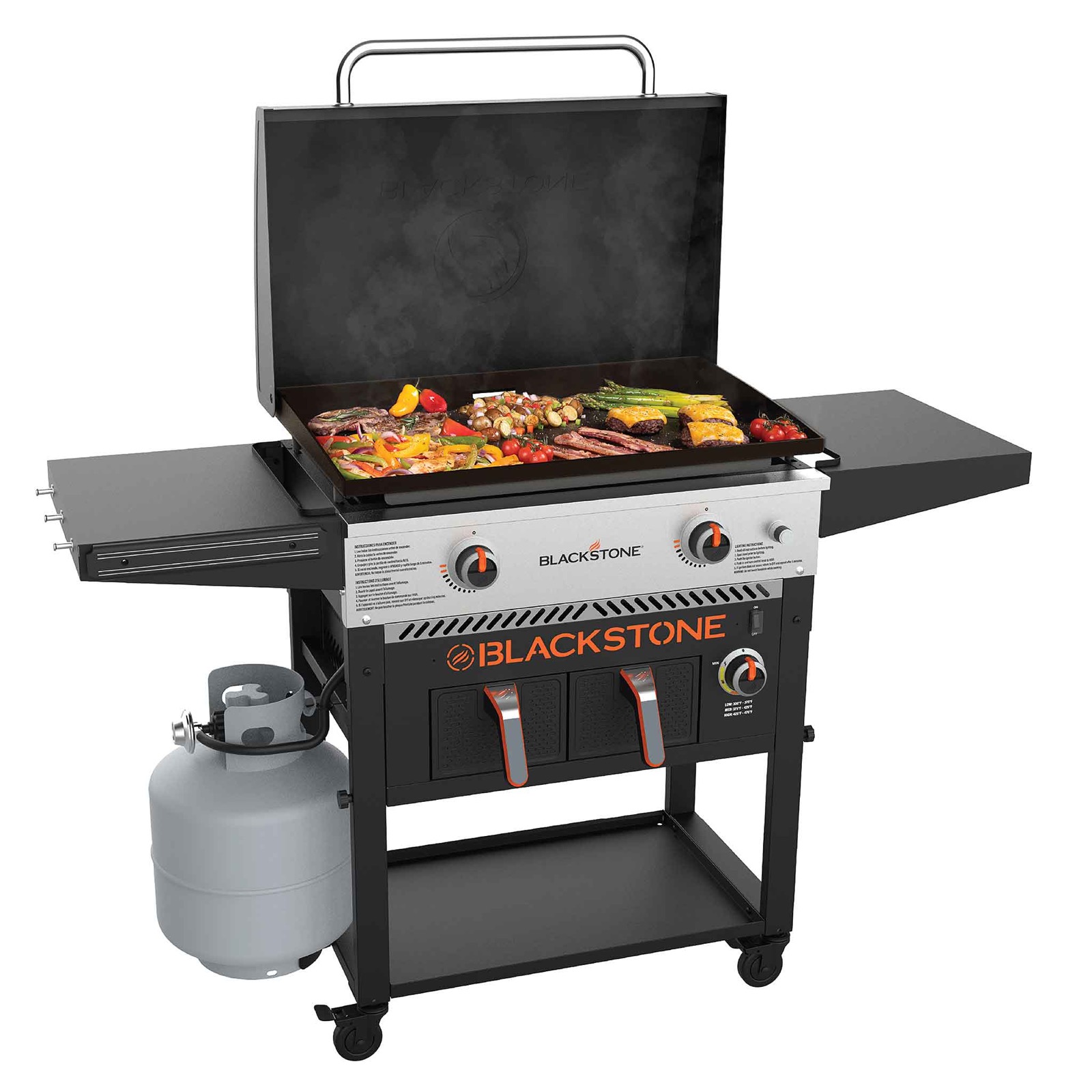
A 28-inch hooded griddle with two drawers built into the cart base: one live 4-quart air fryer on its own 13,000 BTU burner, one 4-quart warming drawer. The griddle itself is the standard two-zone 34,000 BTU 28-inch plate. The whole point is that fries, wings and tots come off the same propane tank as the burgers instead of going inside to an oven.